sliderarrowCloseMenushare_facebookshare_instagramshare_xshare_linkedinshare_threadsshare_shareshare_tranditionalshare_calendarshare_emailicon_threadsconnect_facebookconnect_instagramconnect_xconnect_youtubeconnect_atbtn_arrowhamburger-x
Skip to main content
Collections Menu
CultureChinese
Titles
  • Pair of Candlesticks
Datec. 1760–1780
Made inChina, Asia
MediumPaktong
Dimensions.1, Assembled: 10 1/16 × 4 15/16 × 4 15/16 in. (25.5 × 12.5 × 12.5 cm)
.2, Assembled: 10 × 5 × 4 15/16 in. (25.4 × 12.7 × 12.5 cm)
Credit LineThe Bayou Bend Collection, museum purchase funded by the estate of Susan Neptune
Object numberB.2026.2.1,.2
Current Location
Bayou Bend Collection and Gardens
Music Room
On view

Explore Further

Department
Bayou Bend
Object Type
Description

Paktong—an alloy of copper, nickel, and zinc, originally from China, its name derived from the Cantonese "Baitong"—was highly valued in the West for its close resemblance to more costly silver, as well as its resistance to tarnish and its strength. Chinese understanding of the metallurgy involved in the production of nickel and paktong was far ahead of that in Europe during the 1600s and 1700s, with the result that paktong objects in England and Europe were nearly exclusively Chinese imports. Paktong was used to produce many of the same types of objects as brass, with fire tools and candlesticks among the leading products. With mentions as early as 1597 in our Western world, paktong (also known as tutenag) seems to have appeared around 4 A.D. in China and was later traded to the countries that held colonial or commercial interests in China, including Britain. Due to the scarcity and high demand that the alloy faced, Europeans attempted to re-create it or approximate its composition—such as the 19th-century emergence of German silver, an alloy of similar composition.


ProvenanceDr. Peter Brown; [Jeffrey Tillou Antiques, Litchfield, Connecticut]; purchased by MFAH, 2026.
Inscriptions, Signatures and Marks
Each: Engraved initials on underside: P W
[none]

Cataloguing data may change with further research.

If you have questions about this work of art or the MFAH Online Collection please contact us.

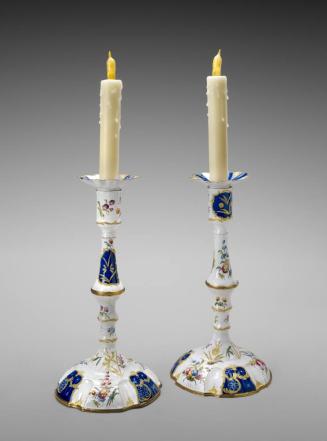
Pair of Candlesticks
Unknown English
c. 1750–1770
Enamel on copper
B.59.37.1,.2
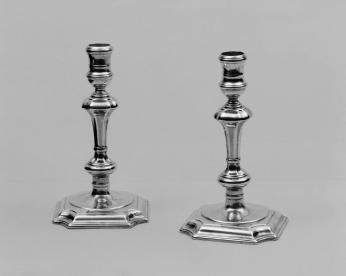
Pair of Candlesticks
Unknown American
c. 1730–1770
Silver
B.83.2.1,.2
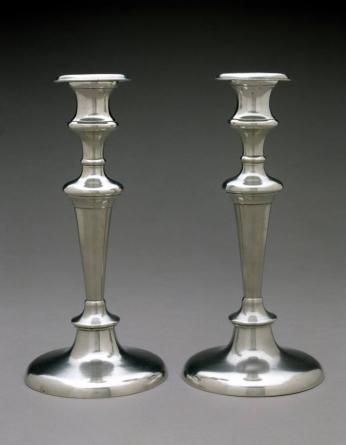
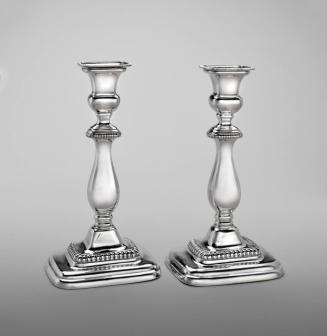
Pair of Candlesticks
Henry Hopper
c. 1842–1847
Britannia metal
B.2002.7.1,.2
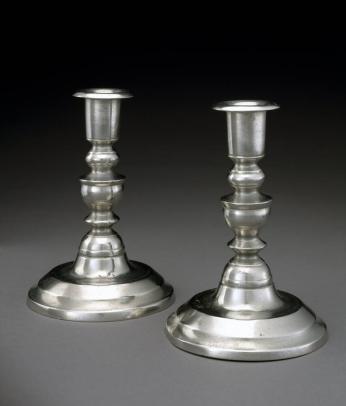
Pair of Candlesticks
Rufus Dunham
c. 1837–1860
Pewter
B.2006.22.1,.2
Pair of Candlesticks
Andrew Ellicott Warner
1815
Silver
B.2022.6.1,.2
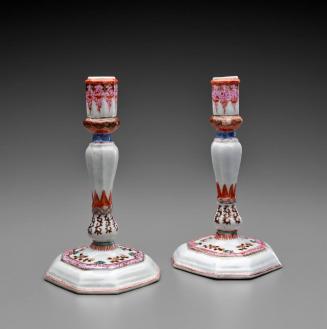
Pair of candlesticks
Unknown Chinese
c. 1760–1770
Hard-paste porcelain with enamel
B.61.62.1,.2
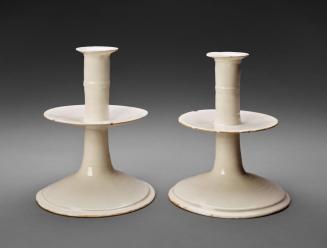
Pair of Candlesticks
Unknown English
c. 1640–1680
Tin-glazed earthenware (delftware)
B.56.171.1,.2
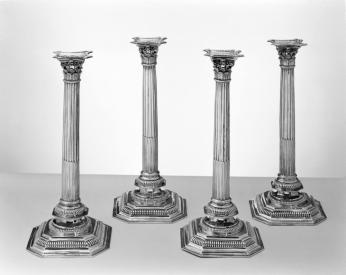
Set of Four Candlesticks
William Caldecott
1756
Silver
B.55.11.1-.4
Pair of Candlesticks
Boston and Sandwich Glass Co.
c. 1820–1830
Blown-molded and pressed glass with base metal and lacquer
B.2004.7.1,.2
Pair of Candlesticks
H. N. Hooper Company
c. 1850–1868
Lead glass, base metal, and lacquer
B.2004.5.1,.2
Pair of Candlesticks
The Royal Crown Derby Porcelain Co. Limited
c. 1760–1770
Soft-paste porcelain
B.70.30.1,.2
Pair of Candlesticks
Christopher Webber Fenton
c. 1852–1858
Lead-glazed earthenware (flint enamel ware)
B.57.14.1,.2
Unknown