God the Father

- God the Father
Explore Further
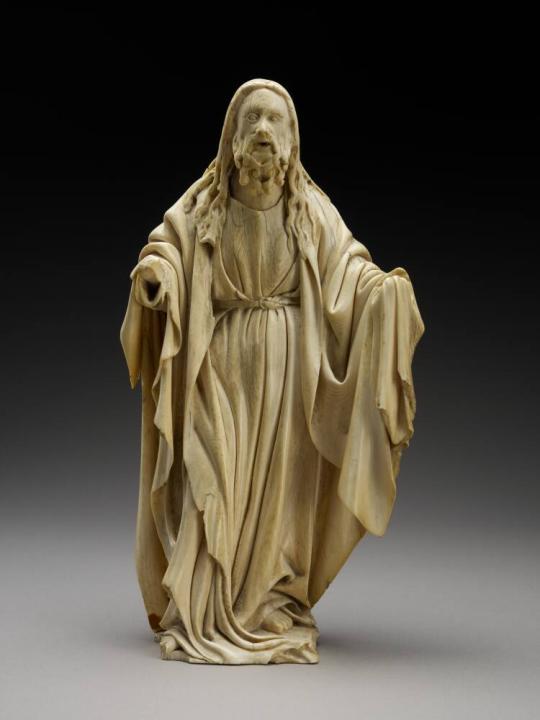
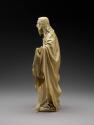
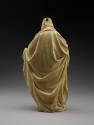
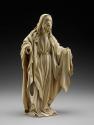
The revolution wrought upon the art of sculpture at the turn of the 14th century in France by a number of Netherlandish sculptors, headed by Claus Sluter and his assistant Claus de Werve, can be appreciated in the exceptionally rare ivory figure God the Father. The brilliant carving suggests that this work must have been an important commission despite its diminutive size. The abundant, spilling folds of drapery that intensify the feeling of volume and weight in the figure, the fleeting quality conveyed by his stance and hand gesture, and the realistically expressive facial features suggest a direct connection with the art of Sluter.
This small sculpture was once part of a group depicting the Christian Trinity: God the Father mostly likely held in his outstretched hand a cross supporting the body of the crucified Christ, and the Holy Spirit was represented by a dove. God the Father reflects the elegance and sophistication of the International Style that arose about 1400 and was characterized by a love of calligraphic outline and curvilinear patterns and marked a tendency toward realistic detail. Originating in the wake of social change that enabled not only princes and dukes but also the lesser nobility to become patrons of the arts, the International Style catered to aristocratic tastes throughout western Europe.
ProvenanceStated to be from Henry Garnier collection, Lyon, France; [Joseph Brummer Gallery, New York]; Percy S. Straus, January 1935; bequeathed to MFAH, 1944.
Exhibition History"A Permanent Heritage: Major Works from the Collection," Museum of Fine Arts, Houston, October 23, 1980–January 4, 1981.
"Images in Ivory: Precious Objects of the Gothic Age," Detroit Institute of Arts, March 9–May 11, 1997; Walters Art Gallery, Baltimore, June 22–August 31, 1997.
"Art from the Court of Burgundy (1363-1419)," Musée des Beaux-Arts, Dijon, France, May 27–September 15, 2004; Cleveland Museum of Art, October 24, 2004–January 9, 2005.
"Passion for Perfection: The Straus Collection of Renaissance Art," Museum of Fine Arts, Houston, October 21, 2017–June 17, 2018.
"New Light on Old Masters: European Art from Houston Collections," Museum of Fine Arts, Houston, October 2, 2021–January 23, 2022.
Published References Catalogue of the Edith A. and Percy S. Straus Collection, the Museum of Fine Arts, Houston, 1945, no. 57. P. Verdier, La Trinité debout de Champmol, Etudes d'art français offertes à Charles Sterling, Paris, 1975, pp. 65-90. D. Gaborit-Chopin, Ivories du Moyen Age, Freiburg, 1978, p. 171, fig. 267. Jack L. Schrader and John Minor Wisdom, Jr., The Museum of Fine Arts, Houston, A Guide to the Collection, 1981, entry #34, p. 20. A. Erlande-Brandenburg, L'art gothique, Paris, 1983, no. 634. R. H. Randall, Masterpieces of Ivory from the Walters Art Gallery, New York, 1985, pp. 184, 188 Marzio, Peter, The Museum of Fine Arts, Houston: A Permanent Legacy, Hudson Hills Press: New York, 1989, p. 100, p. 102 (illus.) Isabel Mosneron Dupin, La Trinité debout en ivoire de Houston et Les Trinités bourguignonnes de Jean de Marville à Jean de la Huerta, "Wierner Jahrbuch für Kunstgeschichte 43", 1990, pp. 35-65, figs. 1-20. K. Morand, Claus Suter , Artist at the Court of Burgundy, Austin and London, 1991, pp. 327, 329, fig. 57. Richard H. Randall, Jr., The Golden Age of Ivory Gothic Carvings in North American Collections, 1993, Hudson Hill Press, (exhibition catalogue for Images in Ivory: Precious Objects of the Gothic Age, Detroit Institute of Arts, March 9 – May 11, 1997; the Walters Art Gallery, Baltimore, June 22 – August 31, 1997), cat. #26, listed as "God the Father from a Trinity, French, Dijon, 1380-1400". Peter Barnet, ed., Images in Ivory. Precious Objects of the Gothic Age, exhibition catalogue, The Detroit Institute of Arts and The Walters Art Gallery, Baltimore, 1997, no. 65. Janet Landay, The Museum of Fine Arts, Houston Visitor Guide, Houston, 2000, no. 1.12 , (illus.) Renate Prochno, Die Kartause von Champmol, Grablege der burgundischen Herzöge 1364-1477, Akademie Verlag, 2002, cat. 31 Paris 1400. Les Arts sous Charles VI, exhibition catalogue, Musée du Louvre, 2004, p. 209. Stephen N. Fliegel, “Patronage and the Burgundian Court (1364-1419)”, The Magazine Antiquities, October 2004, pp.142-151, reproduced p. 149 James Clifton, God in the Art Museum, March 31, 2006, lecture series “Sacred Art in Secular Spaces and Caravaggio’s Artful Ambiguities” Peter C. Marzio with staff of the Museum of Fine Arts, Houston, Masterpieces from the Museum of Fine Arts, Houston, Director’s Choice, Yale University Press, 2009, p. 57 The Courtauld Institute of Art Gothic Ivories Project 2008-2011, Prof. John Lowden and Dr. Catherine Yvard. The Gothic Ivories Project is an online database of ivory sculptures made in Western Europe c. 1200–c.1530 and neo-Gothic ivory pieces. http://www.gothicivories.courtauld.ac.uk/
Cataloguing data may change with further research.
If you have questions about this work of art or the MFAH Online Collection please contact us.