Cruet Stand
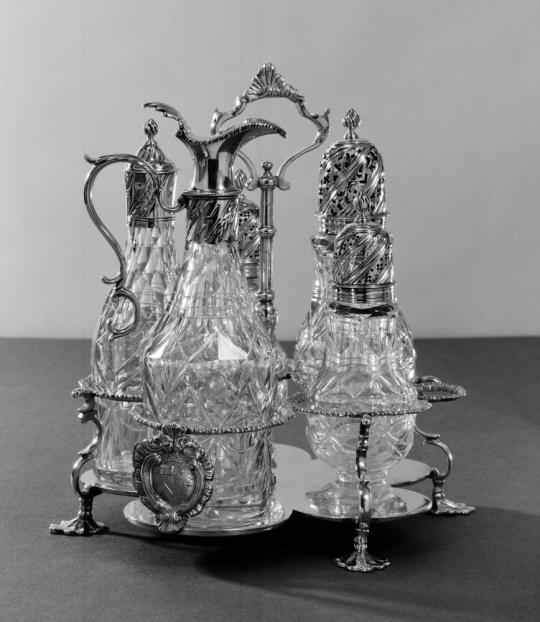
- Cruet Stand
Explore Further
Frames for casters were produced by English silversmiths by the early eighteenth century. The cruet stand was also fitted with glass bottles for condiments such as dry mustard, sugar, pepper, catsup, vinegar, oil, and soy. Marked American examples are rare, as most colonial silversmiths probably chose to import cruet stands, it being more efficient and economical than attempting to produce the complex castings themselves. The close similarity between the Bayou Bend stand and contemporary English examples suggests that John David’s shop derived the cast patterns directly from the latter.
Technical notes: The base is cast, with reinforcing rings for the handle, casters, and bottles. The handle is threaded and screws into the base. The results of a nondestructive energy-dispersive X-ray fluorescence analysis are on file at Bayou Bend.
Related examples: One other cruet stand bears John David’s stamp, in Quimby 1995, pp. 348–49, no. 334. Other Philadelphia examples include one attributed to Jeremiah Elfreth, at Delaware State Museum, Dover; another with the stamp of William Hollingshead in a private collection; and a third by Joseph Richardson, Jr., and Nathaniel Richardson, in Antiques 97 (April 1970), p. 512. English examples with Philadelphia provenances are discussed in Backlin-Landman 1969; Lindsey 1993.
Book excerpt: David B. Warren, Michael K. Brown, Elizabeth Ann Coleman, and Emily Ballew Neff. American Decorative Arts and Paintings in the Bayou Bend Collection. Houston: Princeton Univ. Press, 1998.
ProvenancePresumably for the Chew family; consigned to [Samuel T. Freeman, Philadelphia, 1970]; F. J. Carey III, Penllyn, Pennsylvania; purchased by MFAH, 1982.
Published References Samuel T. Freeman, Philadelphia, December 14, 1970, lot 314; Brown, Michael K. "American Silver at Bayou Bend." The Museum of Fine Arts, Houston Bulletin, n.s., 11, no. 1 (Fall 1987), p. 24. Inscriptions, Signatures and Marks
Cataloguing data may change with further research.
If you have questions about this work of art or the MFAH Online Collection please contact us.