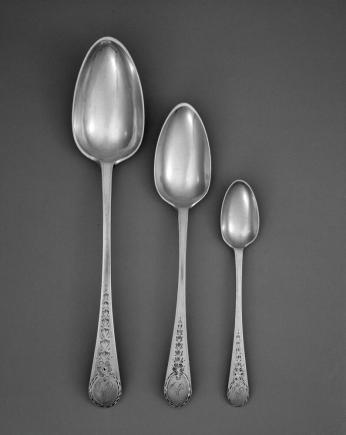
Teaspoon and Spoon
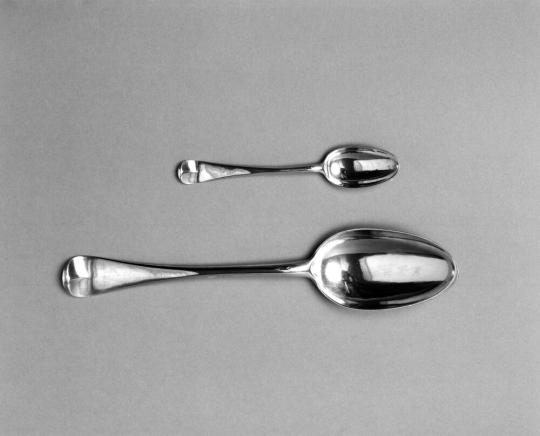
- Teaspoon and Spoon
Spoon: 8 in. (20.3 cm)
Explore Further
The wavy-end spoon was succeeded by the spatulate type, first produced in England about 1710 and in the American colonies the following decade. The earliest examples retain the rat-tail joint, which was soon replaced with either a spatulate drop or a Late Baroque stylized shell. By mid-century a simple double drop, as seen on the Bayou Bend spoons, was introduced as an alternative. The earliest American teaspoons were fashioned during this period. However, it is highly unusual at this date to have matching dining and teaspoons.
Related examples: French 1939, p. 52, no. 312; Antiques 102 (September 1972), p. 368.
Book excerpt: David B. Warren, Michael K. Brown, Elizabeth Ann Coleman, and Emily Ballew Neff. American Decorative Arts and Paintings in the Bayou Bend Collection. Houston: Princeton Univ. Press, 1998.
ProvenanceMark Bortman (1896–1967), Boston; given to his daughter; [William Core Duffy, New Haven]; purchased by MFAH, 1983.
Published References Buhler, Kathryn C. "Early American Silver, American Gold, English Silver in America." In Silver Supplement to the Guidebook to the Diplomatic Reception Rooms. Washington, D.C.: Department of State, 1973, p. 36, nos. 61a, b; Kane, Patricia E., ed. Colonial Massachusetts Silversmiths and Jewelers: A Biographical Dictionary Based on the Notes of Francis Hill Bigelow and John Marshall Phillips. New Haven: Yale University Art Gallery, 1998, pp. 620–21. Inscriptions, Signatures and Marks
Cataloguing data may change with further research.
If you have questions about this work of art or the MFAH Online Collection please contact us.