Rodrigo Moya
Rodrigo Moya
Mexican, 1934–2025
Rodrigo Moya, 91, Dies; Photographed Che and a Changing Latin America
[Image: A black-and-white photo of Rodrigo Moya, a young man with short, dark hair, gazing toward the ceiling. Rodrigo Moya in 1953. He chronicled a tempestuous period in Latin American history, capturing the essence of Mexico during a time of rapid modernization.Credit...Armando Rodríguez, via Moya family]
He documented poverty and protest in the 1950s and ’60s, and he created indelible images of Che Guevara and Gabriel García Márquez.
By Miguel Salazar
Published Aug. 19, 2025
Updated Aug. 21, 2025, 1:27 p.m. ET
Rodrigo Moya, a photojournalist who captured farmworkers, guerrillas and celebrities in Mexico and across Latin America, and whose subjects included the Argentine revolutionary Che Guevara smoking a cigar and the novelist Gabriel García Márquez with a black eye, died on July 30 at his home in Cuernavaca, Mexico. He was 91.
His son Pablo said the cause was a stroke.
Mr. Moya chronicled a tempestuous period in Latin American history. In the 1950s and ’60s, a time of rapid modernization and single-party rule, he documented the poverty and tumult of Mexico. He then widened his focus to photograph armed conflicts throughout the region and luminaries like the Cuban singer Celia Cruz, the novelist Carlos Fuentes and the painter Diego Rivera.
[Image: A black-and-white image of a young, scruffy-looking Mr. Moya sitting outdoors between two armed fighters. Mr. Moya, center, with armed guerrillas in Venezuela in 1966. A committed Marxist, he documented the proliferation of guerrilla armies after the military success of the Cuban revolution. Credit...Rodrigo Moya, via Etherton Gallery]
Although his photographs are considered among the most revelatory of his era — along with the work of contemporaries like Héctor García Cobo and Nacho López — Mr. Moya remained a marginal figure for most of his career.
Armed with two cameras — one for news assignments, the other for personal use — he traveled across Mexico City, documenting strikes, student protests and widespread deprivation.
At the time, his photographs of shopkeepers, schoolchildren and rural laborers were considered too controversial to be published because they contradicted the image of a modern country promoted by the Institutional Revolutionary Party, which had dominated the Mexican government since 1929. He stashed many of them away for decades.
“More than the beltways or the glass-covered skyscrapers that proliferated along the main avenues,” Mr. Moya wrote in a 2008 photo essay, “the city that astonished me was one of textures, of mud and dust and improbable, precarious houses,” populated by “the millions who build the urban center, who pave it and sweep it” and “maintain the movements of the urban clockwork.”
[Image: A black-and-white photo of two men working on power lines, one on a ladder and the other standing below, and two small boys walk by. “Stolen light, Nezahualcóyotl City, Mexico” (1965).Credit...Rodrigo Moya, via Etherton Gallery]
[Image: A black-and-white photograph of a cyclist carrying three very large wicker baskets of bread covered with tarps, riding along a city street. “Baker, Mexico City” (1963).Credit...Rodrigo Moya, via Etherton Gallery]
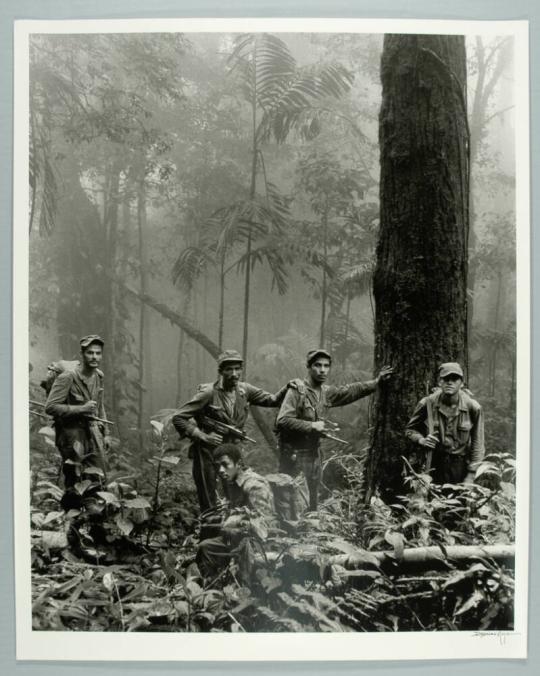
A committed Marxist, he documented the proliferation of guerrilla armies across the region in the 1960s after the military success of the Cuban revolution. He embedded with rebel groups in Guatemala and Venezuela, capturing the fighters as they navigated the jungle in a shroud of fog; infiltrated a United Fruit Company (now Chiquita Brands International) estate in Panama to observe its miserable labor conditions; and photographed the U.S. Army invading the Dominican Republic in 1965.
He also photographed a forlorn Mr. Guevara wielding a cigar in 1964.
[Image: A black-and-white photograph of a young, bearded Che Guevara, looking mournful and smoking a cigar. “Melancholic Che, Havana, Cuba” (1964).Credit...Rodrigo Moya, via Etherton Gallery]
That image came about by happenstance. Mr. Moya, who had traveled to Cuba with a Mexican delegation that included the cartoonist Eduardo del Río, was unexpectedly granted a 15-minute interview with Mr. Guevara after Fidel Castro canceled a previously scheduled meeting. Mr. Guevara, a fan of Mr. del Río’s cartoons, stayed for more than two hours, allowing Mr. Moya to capture him in a range of emotions.
“The Che I photographed,” he said in an interview for the 2007 book “Conversations With Mexican Photographers,” “was one without any historical makeup” — resulting in an unvarnished image of a man burdened by psychological baggage.
[Image: A black-and-white photo of a youngish Celia Cruz, wearing a sleeveless satin top and gold jewelry, her hair pulled back in a braid. “Celia Cruz, Mexico City” (1963).Credit...Rodrigo Moya, via the Wittliff Collections]
Over the course of his career, Mr. Moya shot portraits of a pantheon of Latin American celebrities, including Mr. Rivera, Mr. Fuentes, Ms. Cruz and Gabriel García Márquez, twice — once, in 1967, for the promotional photos for his novel “One Hundred Years of Solitude,” and again in 1976, when Mr. García Márquez unexpectedly arrived on his doorstep with a black eye.
[Image: A black-and-white photo of “Gabriel García Márquez, a middle-aged man with dark hair and a mustache, wearing a houndstooth jacket. “Gabriel García Márquez, Mexico City” (1967).Credit...Rodrigo Moya, via the Wittliff Collections]
Two days earlier, Mr. García Márquez told him, Mario Vargas Llosa had punched him for interfering in his marriage. Mr. García Márquez wanted photos taken as a matter of record. Mr. Moya obliged.
“I was concerned about his melodramatic face,” Mr. Moya recalled decades later, in an interview with the Colombian author Silvana Paternostro for her book “Solitude and Company” (2014). “Then suddenly something happened, I said something and he laughed, and I took two photographs.”
[Image: A black-and-white photo of a smiling Gabriel García Márquez with a black eye.
Mr. Moya’s 1976 image of a battered, grinning Mr. García Márquez was published in the Mexican newspaper La Jornada in 2007, inspiring years of literary gossip.Credit...Rodrigo Moya Archive]
He held on to the negatives for more than 30 years before he published the now-famous image of a battered, grinning Mr. García Márquez in the Mexican newspaper La Jornada on the author’s birthday in 2007, inspiring years of literary gossip.
“I’ve never made so much money from a photograph,” Mr. Moya told The Paris Review.
Luis Rodrigo Moya Moreno was born on April 10, 1934, in Medellín, Colombia. His father, Luis Moya Sarmiento, was a painter and set designer from Mexico; his mother, Alicia Moreno Vélez, ran the home.
After the family moved to Mexico City in 1937, Rodrigo attended the Colegio Madrid, a school run by Republicans who had fled Spain during the country’s civil war. He enrolled in the engineering program at the National Autonomous University of Mexico but dropped out in 1954 and took a job in a Mexican television studio.
His family home was a gathering spot for Colombian artists and writers, including Mr. García Márquez, the painter Pedro Nel Gómez and the photographer Guillermo Angulo, who offered Rodrigo photography lessons in exchange for instruction on how to operate a TV camera.
[Image: A black-and-white photo of five scruffy-looking men with guns in a jungle.
“Guerrillas in the Fog, Sierra de Falcón, Venezuela” (1965).Credit...Rodrigo Moya, via Etherton Gallery]
[Image: A black-and-white photo of two men carrying a very large fish on a bicycle.
“Marlin on a Bicycle, Ensenada, B.C.N., Mexico” (1968).Credit...Rodrigo Moya, via Etherton Gallery]
Mr. Angulo, who worked for Impacto magazine, offered him an internship there; within a year, Mr. Moya had been hired as a staff photographer.
By 1967, the year Mr. Guevara died, Mr. Moya had become disillusioned with armed leftists and with the self-censorship of the Mexican press.
He abandoned photojournalism and started a monthly fishing trade magazine, Tecnica Pesquera. For the next 22 years, until it closed in 1990, he edited the magazine, wrote for it and occasionally supplied the photography.
In 1999, after he was diagnosed with pancreatic cancer, Mr. Moya moved to Cuernavaca and began sifting through his archive of some 40,000 photos. In 2004, he published a collection of photography called “Foto Insurrecta”; it was then that his work found a second life, drawing attention in exhibitions across Mexico and abroad.
[Image:A black-and-white photo of a young girl looking out a train window next to an older person. “The Girl,” from the series “The Little Train” (1966).Credit...Rodrigo Moya, via Etherton Gallery]
[Image: A black-and-white phot of an older man wearing a cowboy hat, his dirt-encrusted hands in the foreground. “Life Isn’t Beautiful, Coahuila, Mexico” (1965).Credit...Rodrigo Moya, via Etherton Gallery]
In its listing for a 2013 show at Throckmorton Fine Art in Midtown Manhattan, The New Yorker noted that Mr. Moya’s photography “flirts with some of photojournalism’s favorite clichés (the adorable waif, the stoic farmhand) but avoids them with wit, restraint, and a formal elegance that recalls the Bauhaus.”
Mr. Moya eventually published 11 photography collections and catalogs, including “Photography and Conscience/Fotografía y Conciencia” (2015), a bilingual volume issued by the University of Texas Press. A selection from his archive is held by the Wittliff Collections at Texas State University.
[Image: A book cover with a photograph of an unhappy-looking man with short, tousled hair above a yellow strip with the words “Rodrigo Moya” in large black letters. Mr. Moya published 11 photography collections and catalogs, including “Photography and Conscience/Fotografía y Conciencia” (2015).Credit...University of Texas Press.]
An accomplished writer, Mr. Moya also published two short-story collections. His 1999 book, “Cuentos Para Leer Junto al Mar” (“Stories to Read by the Sea”), was awarded a short story prize by the National Institute of Fine Arts and Literature in Mexico.
Mr. Moya married Annunziata Rossi, a professor of literature at the National Autonomous University of Mexico, in 1959. The marriage ended in divorce in 1964. In addition to their son Pablo, he is survived by Susan Flaherty, an illustrator, whom he married in 1982. Two other children from his first marriage, Nicolás and Giovanna Moya, died earlier.
Throughout his career, Mr. Moya shot mostly on 35-millimeter and six-by-six medium-format cameras, rigorously curating his images and trimming them after development for composition. He did not consider himself a stylist and lamented the growing dominance of aestheticism over straight documentation in photography.
When asked how he would categorize his work in 2007, he described it as “documentary, realist, humanist and ideologically committed.”
It had been that way “for a long time,” he added. “I’ll die with this commitment.”
Emiliano Rodríguez Mega contributed reporting.
________________________________________________________________________
https://www.sanjuandailystar.com/post/rodrigo-moya-who-photographed-a-changing-latin-america-dies-at-91
Rodrigo Moya, who photographed a changing Latin America, dies at 91
Writer: The San Juan Daily Star
The San Juan Daily Star
[Image: Mexican photojournalist Rodrigo Moya (Facebook via The Wittliff Collection)]
By Miguel Salazar
Rodrigo Moya, a photojournalist who captured farmworkers, guerrillas and celebrities in Mexico and across Latin America, and whose subjects included Argentine revolutionary Che Guevara smoking a cigar and novelist Gabriel García Márquez with a black eye, died July 30 at his home in Cuernavaca, Mexico. He was 91.
His son Pablo said the cause was a stroke.
Moya chronicled a tempestuous period in Latin American history. In the 1950s and ’60s, a time of rapid modernization and single-party rule, he documented the poverty and tumult of Mexico. He then widened his focus to photograph armed conflicts throughout the region and luminaries like Cuban singer Celia Cruz, novelist Carlos Fuentes and painter Diego Rivera.
Although his photographs are considered among the most revelatory of his era — along with the work of contemporaries like Héctor García Cobo and Nacho López — Moya remained a marginal figure for most of his career.
Armed with two cameras — one for news assignments, the other for personal use — he traveled across Mexico City, documenting strikes, student protests and widespread deprivation.
At the time, his photographs of shopkeepers, schoolchildren and rural laborers were considered too controversial to be published because they contradicted the image of a modern country promoted by the Institutional Revolutionary Party, which had dominated the Mexican government since 1929. He stashed many of them away for decades.
“More than the beltways or the glass-covered skyscrapers that proliferated along the main avenues,” Moya wrote in a 2008 photo essay, “the city that astonished me was one of textures, of mud and dust and improbable, precarious houses,” populated by “the millions who build the urban center, who pave it and sweep it” and “maintain the movements of the urban clockwork.”
A committed Marxist, he documented the proliferation of guerrilla armies across the region in the 1960s after the military success of the Cuban revolution. He embedded with rebel groups in Guatemala and Venezuela, capturing the fighters as they navigated the jungle in a shroud of fog; infiltrated a United Fruit Co. (now Chiquita Brands International) estate in Panama to observe its miserable labor conditions; and photographed the U.S. Army invading the Dominican Republic in 1965.
[Image: Peluquería, Ixmiquilpan, Hidalgo, México,” 1955, gelatin silver print (Instagram via ethertongallery)]
Over the course of his career, Moya shot portraits of a pantheon of Latin American celebrities, including Rivera, Fuentes, Cruz and García Márquez, twice — once, in 1967, for the promotional photos for his novel “One Hundred Years of Solitude,” and again in 1976, when García Márquez unexpectedly arrived on his doorstep with a black eye.
Two days earlier, García Márquez told him, Mario Vargas Llosa had punched him for interfering in his marriage. García Márquez wanted photos taken as a matter of record. Moya obliged.
“I was concerned about his melodramatic face,” Moya recalled decades later, in an interview with Colombian author Silvana Paternostro for her book “Solitude and Company” (2014). “Then suddenly something happened, I said something and he laughed, and I took two photographs.”
He held on to the negatives for more than 30 years before he published the now-famous image of a battered, grinning García Márquez in the Mexican newspaper La Jornada on the author’s birthday in 2007, inspiring years of literary gossip.
“I’ve never made so much money from a photograph,” Moya told The Paris Review.
Luis Rodrigo Moya Moreno was born on April 10, 1934, in Medellín, Colombia. His father, Luis Moya Sarmiento, was a painter and set designer from Mexico; his mother, Alicia Moreno Vélez, ran the home.
After the family moved to Mexico City in 1937, Rodrigo attended the Colegio Madrid, a school run by Republicans who had fled Spain during the country’s civil war. He enrolled in the engineering program at the National Autonomous University of Mexico but dropped out in 1954 and took a job in a Mexican television studio.
His family home was a gathering spot for Colombian artists and writers, including García Márquez, painter Pedro Nel Gómez and photographer Guillermo Angulo, who offered Rodrigo photography lessons in exchange for instruction on how to operate a TV camera.
Angulo, who worked for Impacto magazine, offered him an internship there; within a year, Moya had been hired as a staff photographer.
By 1967, the year Guevara died, Moya had become disillusioned with armed leftists and with the self-censorship of the Mexican press.
[Image: Che Guevara in 1964, vintage gelatin silver print (Pinterest via Rodrigo Moya)]
He abandoned photojournalism and started a monthly fishing trade magazine, Tecnica Pesquera. For the next 22 years, until it closed in 1990, he edited the magazine, wrote for it and occasionally supplied the photography.
In 1999, after he was diagnosed with pancreatic cancer, Moya moved to Cuernavaca and began sifting through his archive of some 40,000 photos. In 2004, he published a collection of photography called “Foto Insurrecta”; it was then that his work found a second life, drawing attention in exhibitions across Mexico and abroad.
In its listing for a 2013 show at Throckmorton Fine Art in midtown Manhattan, The New Yorker noted that Moya’s photography “flirts with some of photojournalism’s favorite clichés (the adorable waif, the stoic farmhand) but avoids them with wit, restraint, and a formal elegance that recalls the Bauhaus.”
Moya eventually published 11 photography collections and catalogs, including “Photography and Conscience/Fotografía y Conciencia” (2015), a bilingual volume issued by the University of Texas Press. A selection from his archive is held by the Wittliff Collections at Texas State University.
An accomplished writer, Moya also published two short-story collections. His 1999 book, “Cuentos Para Leer Junto al Mar” (“Stories to Read by the Sea”), was awarded a short story prize by the National Institute of Fine Arts and Literature in Mexico.
Moya married Annunziata Rossi, a professor of literature at the National Autonomous University of Mexico, in 1959. The marriage ended in divorce in 1964. In addition to their son Pablo, he is survived by Susan Flaherty, an illustrator, whom he married in 1982. Two other children from his first marriage, Nicolás and Giovanna Moya, died earlier.
Person TypePerson