Side Chair (one of a pair)

- Side Chair (one of a pair)
Explore Further
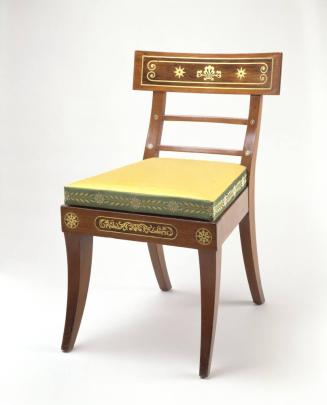
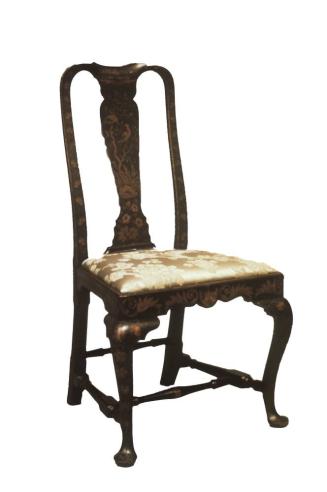
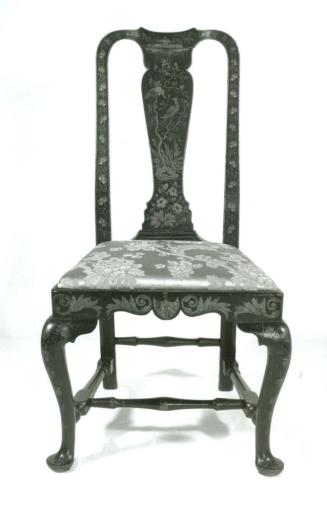
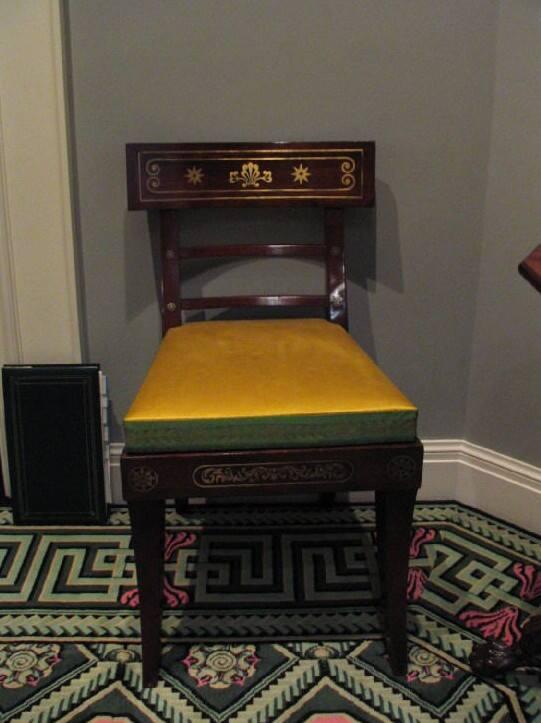
These chairs, with wide tablets and rigorous classical lines, represent a Philadelphia type of Grecian chair. While the design source ultimately derives from Thomas Hope (1769–1831) and his archaeologically correct furniture, the designs of Benjamin Latrobe and the furniture he made for William Waln in 1808 may represent a more immediate inspiration (see B.90.9.1–.2). The overall character of the chairs suggests English influences. The severe surfaces are ornamented with both lavish brass inlay and exotic woods—ebony and rosewood—in accordance with the suggestions of both Thomas Hope and George Smith (act. 1804–28). The inlaid brass decoration, imported from English sources, appears in related combinations on other forms of Philadelphia-made furniture. This brass is let into the wood in the English manner rather than applied, as was the French custom. While the form is not listed in the 1828 Philadelphia price book, that source shows that brass stringing was two and one-half times the cost of wood, indicating that these were expensive chairs.
Technical notes: Mahogany, ebony rosewood (tablet); ash (seat frame), eastern white pine (slip seat), brass (inlay). One seat is numbered III, and the other is numbered V. The seat frames were built up in 1993 to conform to the design found on the Winterthur set, which retains its original upholstery foundations.
Related examples: These chairs were originally part of a set of twelve. Two others are at PMA (PMA 1976, pp. 266–67); two in the Kaufman Collection, Norfolk, Virginia (Flanigan 1986, p. 138, no. 50); and six others are in a private Texas collection. Another identical set of nine are at Winterthur (Fennimore et al. 1994, p. 70). A single example with ebony Greek key inlay rather than brass and a similar Powel family history is at MMA (acc. no. 1986–449, see PMA 1976, pp. 266–67; Biddle 1963, p. 17, no. 34); six others identical in form but with carved rosettes on the seat rail and tablet are in the collection of the Governor’s Mansion, Austin; a pier table at Winterthur is ornamented with the same combination of ostrich feather and star brass inlay (Montgomery 1966b, p. 366, no. 348).
Book excerpt: David B. Warren, Michael K. Brown, Elizabeth Ann Coleman, and Emily Ballew Neff. American Decorative Arts and Paintings in the Bayou Bend Collection. Houston: Princeton Univ. Press, 1998.
ProvenanceBy tradition owned by Thomas Powel Hare, who changed his name to Thomas Hare Powel (1786–1856), Philadelphia, 1826 [1]; by descent to Esther Binney Hare (1872–1967), Radnor, Pennsylvania, until 1968; Estate of Esther Binney Trump; purchased by [R. T. Trump and Company, Philadelphia]; purchased by Miss Ima Hogg, 1969; given to MFAH, 1969.
[1] For his Greek Revival style house, Powelton.
Published References Advertisement of R. T. Trump & Co, The Magazine Antiques 95 (January 1969), p. 57; Warren, David B. "The Empire Style at Bayou Bend: New Period Rooms in Houston. The Magazine Antiques 97 (January 1970), p. 126; Warren, David B. "A Great Texas Collection of Americana: The Bayou Bend Collection at the Museum of Fine Arts, Houston." The Connoisseur 178 (September 1971), p. 48, no. 18; Warren, David B. Bayou Bend: American Furniture, Paintings and Silver from the Bayou Bend Collection. Houston: Museum of Fine Arts, Houston; Boston: New York Graphic Society, 1975, p. 94, no. 177. Inscriptions, Signatures and Marks
Cataloguing data may change with further research.
If you have questions about this work of art or the MFAH Online Collection please contact us.