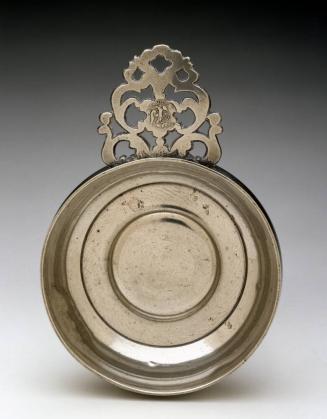
Porringer
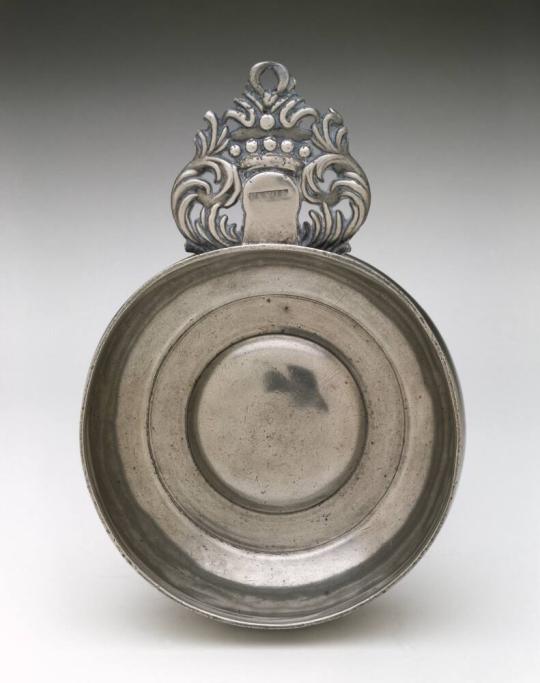

- Porringer
Explore Further
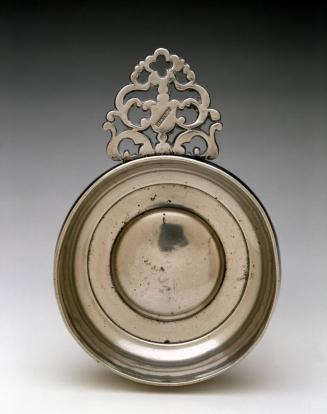
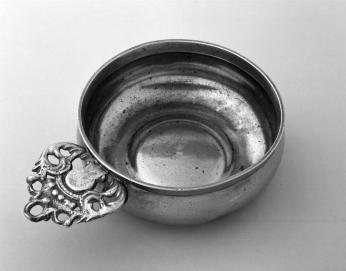
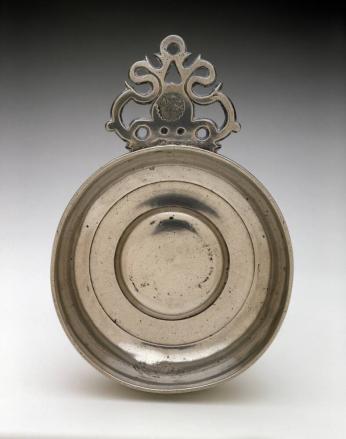
The crown-handle porringer, as its emblematic design suggests, is patterned after English examples. In the American colonies this motif was probably produced first during the mid-eighteenth century by a group of New York pewterers and subsequently by their Boston, Newport, Connecticut, and Pennsylvania counterparts. The political disparity between England and its American colonies does not seem to have impacted the royalist symbol’s acceptance, for pewterers, such as the Boardmans, continued to find a market for it among the newly independent Americans.
Related examples: Winchester et al. 1959, p. 188, no. 4; Hood 1965. pp. 24, 27, nos. 90, 109; Kernan, Ross, and Eilers 1969, pp. 26, 59, no. 65; Fairbanks 1974, p. 35, no. 124; Montgomery 1978, p. 146, no. 9–1.
Book excerpt: David B. Warren, Michael K. Brown, Elizabeth Ann Coleman, and Emily Ballew Neff. American Decorative Arts and Paintings in the Bayou Bend Collection. Houston: Princeton Univ. Press, 1998.
ProvenancePossibly [Thomas D. and Constance R. Williams, Litchfield, Connecticut]; purchased by Miss Ima Hogg, 1956; given to MFAH, by 1966.
Published References Butler, Barbara. “Pewter at Bayou Bend.” The Pewter Collectors’ Club of America 90−91 (March–September 1985), p. 12. Inscriptions, Signatures and Marks
Cataloguing data may change with further research.
If you have questions about this work of art or the MFAH Online Collection please contact us.