Coffeepot

- Coffeepot
Explore Further
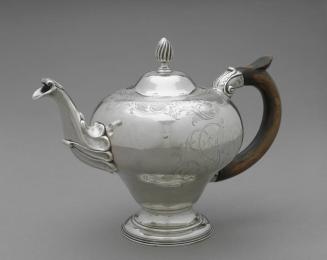
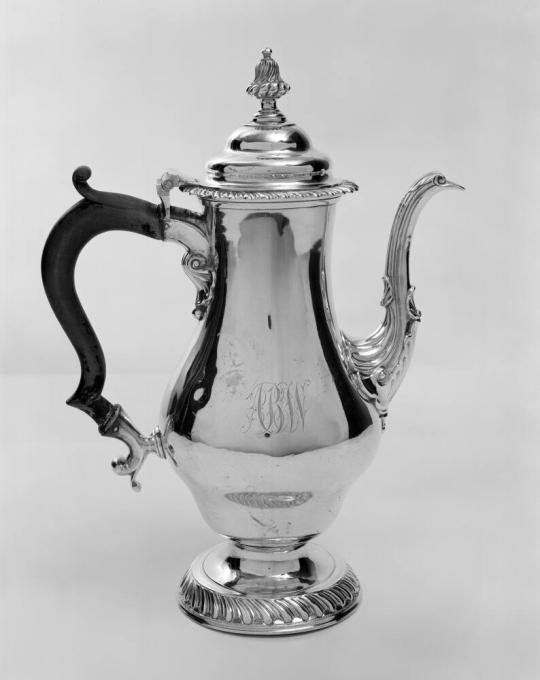
Philadelphians were probably introduced to Rococo design through imported English silver. In response to the new style, the coffeepot, like other vessels, evolved from the single-bellied to the double-bellied shape. The addition of cast elements—finials, handle sockets, and spouts, along with gadrooned rims, engraved ornament, and a scrolled wooden handle—completed the form’s transformation.
Technical notes: The finial is soldered.
Related examples: One other Bayly coffeepot is recorded, at the Sterling and Francine Clark Art Institute, Williamstown, Massachusetts (acc. no. 1962.3).
Book excerpt: David B. Warren, Michael K. Brown, Elizabeth Ann Coleman, and Emily Ballew Neff. American Decorative Arts and Paintings in the Bayou Bend Collection. Houston: Princeton Univ. Press, 1998.
ProvenanceAlexander Belt Wickersham; given to Frances Belt (Mrs. Robert Hadfield, Bt., F.R.S.); [Thomas Lumley, London, by 1941]; [Firestone and Parson, Boston]; purchased by Miss Ima Hogg, 1970; given to MFAH, 1971.
Exhibition History"Theta Charity Antiques Show", Albert Thomas Convention Center, Houston, September 25–29, 1985 (LN:85.31)
Published References Connoisseur 107, no. 476 (May 1941), inside front cover; The Magazine Antiques 98 (September 1970), p. 364; Failey, Dean F. "Silver Coffeepot by John Bayly" The Museum of Fine Arts, Houston Bulletin, n. s., 2, no. 5 (September 1971), p. 64; The Magazine Antiques 103 (February 1973), p. 251; Warren, David B. Bayou Bend: American Furniture, Paintings and Silver from the Bayou Bend Collection. Houston: Museum of Fine Arts, Houston; Boston: New York Graphic Society, 1975, p. 64; Almquist, Barbara A. "A Touch of Class: Silver in Social Settings." In The 1996 Philadelphia Antiques Show: A Benefit for the Hospital of the University of Pennsylvania, p. 44. Inscriptions, Signatures and Marks
Cataloguing data may change with further research.
If you have questions about this work of art or the MFAH Online Collection please contact us.