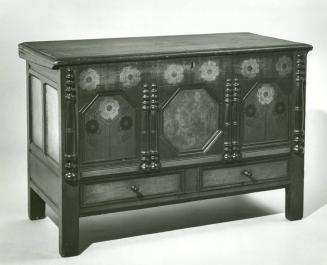
Chest with Drawers
- Chest with Drawers
Explore Further
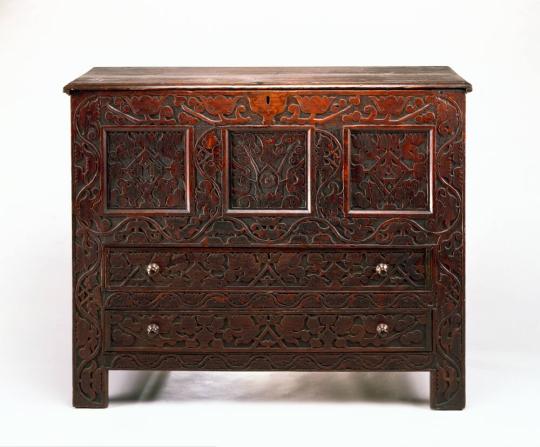
This chest with upper storage area, accessed via a lift top, and two lower drawers represents a relatively common form of case furniture in late-seventeenth-century New England. These chests, produced by joiners using mortise-and-tenon construction, reflect the traditional techniques of joinery of Elizabethan and Jacobean England transferred to the New World. Typically, the drawers are suspended on side runners, as seen in the present example. The carved ornament of the facade makes this chest, and the group to which it belongs, distinctive. The vine, tulip, and leaf motif appears with variations on a relatively large number of surviving chests produced in the Connecticut River valley around Hatfield and Hadley, Massachusetts, and possibly as far south as Hartford, Connecticut. Features of the Bayou Bend chest that point to its origins in the Hatfield area are the undulating vines on the stiles and the lozenges with initials, rosettes, and tulips on the panels.
Technical notes: White oak (right front leg, right bottom rail); southern yellow pine (lift top, bottom, backboard of bottom drawer), red oak (right side of upper drawer). Lift top and pulls are replaced. Backboard is a beveled panel let into the frame of the chest section; a different board with chamfered edges is nailed to the back of the drawer section. The drawer is side-hung. The beveled drawer bottom is let into the front and nailed to the sides and back, with grain running side to side. The drawer sides are half-lapped front and back. There is an inscription: Mary Allyns Chistt Cutte and joined by Nich: Disbrowe (now considered spurious; see Hoopes 1933, p. 171).
Related examples: Kane 1975, pp. 110–11, discusses eleven closely related examples.
Book excerpt: David B. Warren, Michael K. Brown, Elizabeth Ann Coleman, and Emily Ballew Neff. American Decorative Arts and Paintings in the Bayou Bend Collection. Houston: Princeton Univ. Press, 1998.
Provenance[Ginsburg & Levy, New York, by 1954]; purchased by Miss Ima Hogg, 1954; given to MFAH, prior to 1969.
Published References Agee, William C., et al. The Museum of Fine Arts, Houston: A Guide to the Collection, p. 63, no. 112. Houston: Museum of Fine Arts, Houston, 1981; Comstock, Helen. American Furniture, Seventeenth, Eighteenth, and Nineteenth Century Styles, no. 55. New York: Viking Press, 1962; “International Sale-room,” p. 60, no. 5. Connoisseur 134 (September 1954); Kane, Patricia E. “Seventeenth Century Furniture of the Connecticut Valley: The Hadley Chest Reappraised,” p. 80. In Winterthur Conference Report 1974: Arts of the Anglo-American Community in the Seventeenth Century. Edited by Ian M. G. Quimby. Charlottesville: University Press of Virginia for the Henry Francis du Pont Winterthur Museum, 1975; Keyes, Homer Eaton. “The Editor’s Attic,” pp. 114–15. The Magazine Antiques 4 (September 1923); Lockwood, Luke Vincent. Colonial Furniture in America, pp. 335–37. New York: Castle Books, 1957; Ormsbee, Thomas H. Early American Furniture Makers: A Social and Biographical Study, pp. 31–32, pl. V. New York: Archer House, 1957; Sack, Albert. Fine Points of Furniture: Early American, p. 108. New York: Crown Publishers, 1950; Sherrill, Sarah B. “Connoisseurship,” p. 204. The Magazine Antiques 128 (August 1985); Warren, David B. Bayou Bend: American Furniture, Paintings and Silver from the Bayou Bend Collection, p. 16, no. 31. Houston: Museum of Fine Arts, Houston; Boston: New York Graphic Society, 1975. Inscriptions, Signatures and Marks
Cataloguing data may change with further research.
If you have questions about this work of art or the MFAH Online Collection please contact us.