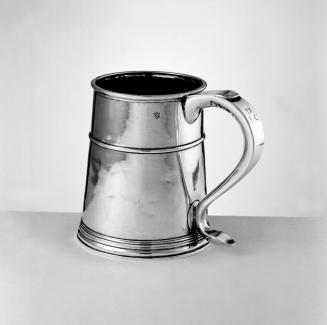
Tankard


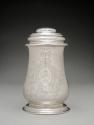

- Tankard
Explore Further
John Bayly, Sr., was a Philadelphia silversmith born around 1725. His father, John Bayly (d. 1752), a cordwainer, or shoemaker, who owned several properties, helped provide the family with financial stability. Although Bayly’s training is not documented, scholars believe he may have apprenticed with the noted silversmith Philip Syng, Jr. Bayly’s son, John Bayly, Jr., also worked as a silversmith, and their pieces were long confused with one another until researchers began separating their work in 1967. Recent scholarship credits Bayly, Sr., with producing some of the finest Philadelphia silver of the third quarter of the 1700s.
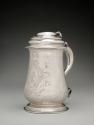
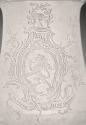
This tankard is an outstanding example of the baluster, or "bellied," form, a style closely associated with Philadelphia silversmiths. Bayly’s version is notable for its tall, slender profile, which sets it apart from similar work by his contemporaries. The engraved Buchanan coat of arms is a particularly bold and expressive Rococo design.
The tankard is believed to have been made for William Buchanan of Baltimore (1748–1824). Buchanan is best known for his lengthy service as the Register of Wills of Baltimore County (1778–1824). He was also a member of a committee of correspondence, an important colonial communication network for patriots during the American Revolution. William Buchanan’s parents were George Buchanan and Eleanor Rogers. Upon his mother’s death in 1758, when he was just a child, William Buchanan inherited enslaved individuals: Rachel, Joshua, "son [and daughter] to Rubie," Ruth, and "the younger son of Penny." It is unknown what happened to these enslaved people, but William Buchanan continued to own enslaved people throughout his life.
On November 26, 1772, Buchanan married his first wife, Margaret Hill Dorsey. Together they had several children, some of whom died during childhood. Margaret died in 1797. Two years later, on November 9, 1799, William Buchanan married his second wife, Hephzibah Brown. They had more children together. Upon his death in 1824, Buchanan divided his property among four of his surviving children—Ann, James M., Susan, and Charles A.—and his wife, Hephzibah.
James M. Buchanan went on to become involved in state and national politics. Throughout his professional life, James was a lawyer, a member of the state legislature, postmaster of Baltimore, a delegate to the Maryland state constitutional convention, a judge, a member of the Democratic convention that nominated James Buchanan for president in 1856, and minister to Denmark (1858–61).
Hephzibah’s will specified that, upon her death, the remaining enslaved people would become free—one of whom may have been Henry, whom Buchanan left to her in his will. It is currently unknown through which line the silver tankard descended.
ProvenanceProbably made for William Buchanan (1748–1824), Baltimore; by descent; consigned to [Christie’s New York, January 21, 2022, lot 287]; purchased by [S. J. Shrubsole, New York]; Roy J. Zuckerberg, New York; consigned to [Sotheby’s, New York]; purchased by MFAH, 2026.
Inscriptions, Signatures and Marks
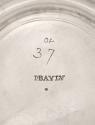
Engraved on underside of base: Oz / 37
Cataloguing data may change with further research.
If you have questions about this work of art or the MFAH Online Collection please contact us.