The Scourged Back
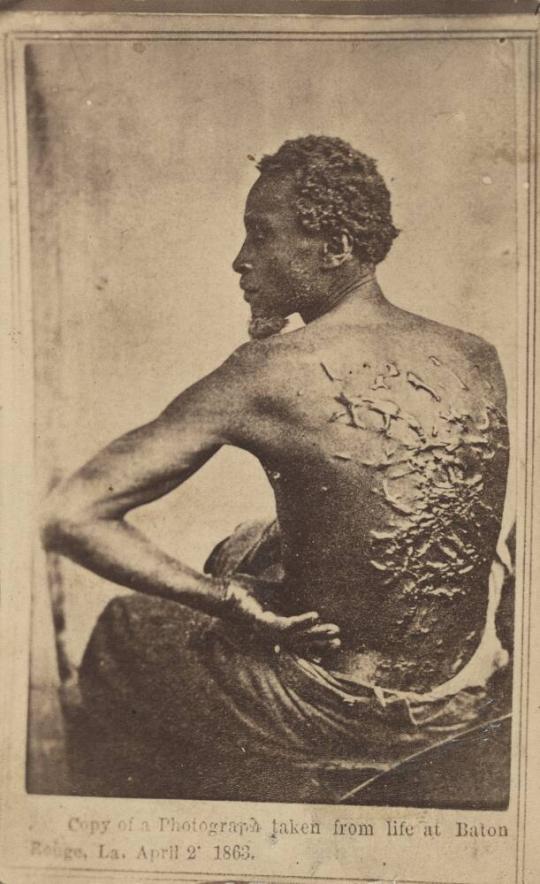
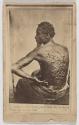
- The Scourged Back
- Gordon Under Medical Inspection
Sheet: 3 5/8 × 2 3/16 in. (9.2 × 5.6 cm)
Mount: 4 × 2 3/8 in. (10.1 × 6.1 cm)
Explore Further
After repeatedly being beaten and whipped at a Louisiana plantation, this man escaped from slavery and fled to a Union camp at Baton Rouge in March 1863, where a camp photographer took a series of photographs that graphically demonstrated the brutality he had endured. The image was copied by other photographers and reproduced in Harper’s Weekly, prompting one contemporary commentator at the time to write, “This card-photograph should be multiplied by the hundred thousand, and scattered over the states.” Even today, it remains powerful proof of the inhumanity of America’s antebellum slavery system.
Provenance[Swann Auction Galleries, New York, Printed & Manuscript African Americana, March 25, 2021, Lot 7]; purchased by MFAH, 2021.
Published References Aamodt, Terrie Dopp. "Matthew Fox-Amato. Exposing Slavery: Photography, Human Bondage, and the Birth of Modern Visual Politics in America." (2020): 1783-1786. Bernier, Celeste-Marie. "A ‘Typical Negro’or a ‘Work of Art’? The ‘Inner’via the ‘Outer Man’in Frederick Douglass's Manuscripts and Daguerreotypes." Slavery & Abolition 33, no. 2 (2012): 287-303. Collins, Kathleen. "The scourged back." History of Photography 9, no. 1 (1985): 43-45. Diepold, Markus. "Picturing Racial Pain: Corporeality and Personhood in Abolitionist Photographs and Lynching Postcards." Ewing, Samuel Dylan. "Sojourner Truth’s Fugitive Images and the Disruptive Power of Circulation Anxiety." Athanor 31 (2013): 63-69. Finnegan, Cara A. "Slave photographs in Lincoln." Rhetoric & Public Affairs 18, no. 1 (2015): 129-134. Goodyear III, Frank H. "The Blue and Gray in Black and White: A History of Civil War Photography." The Journal of Southern History 73, no. 2 (2007): 472. Jackson, Cassandra. "Visualizing Slavery: Photography and the Disabled Subject in the Art of Carrie Mae Weems." Blackness and Disability: Critical Examinations and Cultural Interventions (2011): 31-46. Rogers, Molly. "The work of atrocity photography." The Routledge Companion to Photography Theory (2019).Silkenat, David. "“A Typical Negro”: Gordon, Peter, Vincent Colyer, and the Story behind Slavery's Most Famous Photograph." American Nineteenth Century History 15, no. 2 (2014): 169-186. Strick, Simon. American dolorologies: Pain, sentimentalism, biopolitics. SUNY Press, 2014. Sauers, Cameron T. "War’s Tragic Pawn." (2018). Trodd, Zoe. "Am I still not a man and a brother? Protest memory in contemporary antislavery visual culture." Slavery & Abolition 34, no. 2 (2013): 338-352. Inscriptions, Signatures and Marks
Cataloguing data may change with further research.
If you have questions about this work of art or the MFAH Online Collection please contact us.