Box
- Box
Explore Further
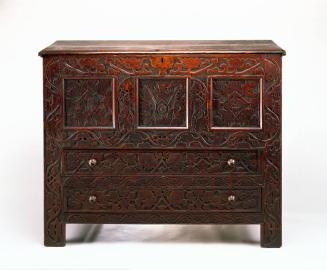
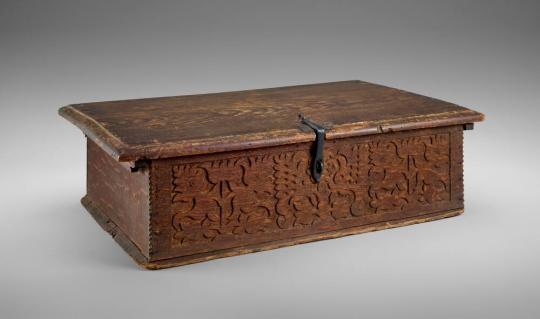
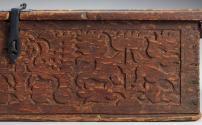
This late 17th-century carved box is attributed to cabinetmaker Thomas Stoughton IV (1662–1748) of Windsor, Connecticut. Although labeled “Bible boxes” by collectors, it is likely that objects such as this once held small valuables and documents.
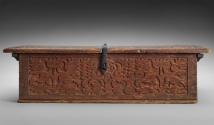
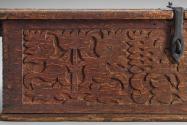
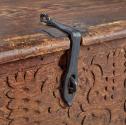
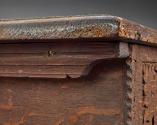
In its overall configuration and construction, the box is typical of the form. Oak boards forming the sides are nailed together, with a wide pine board forming the bottom and nailed from the underside. Simple snipe hinges connect the molded top to the backboard, and molded cleats on either side of the lid add stability. The front board features a tripartite carved design of stylized floral and foliate motifs. Although they share similarities in conception and execution, carving details on similar objects differ according to the shop tradition from which they originated. The unique characteristics of their carving have led scholars to refer to objects from the Stoughton shop tradition as the “serrated foliate group.” This example has survived in remarkable condition, with all of its original wooden components and a fine old surface without later overpainting. Looking closely, one can discern the marks of the cabinetmaker’s tools used to lay out and carve the design. An original iron lock is missing, and the box received a later forged-iron hasp closure. Its condition is indeed exceptional, and the box’s history is equally compelling.
In 1630, Thomas Stoughton Jr., his brother Israel, and their families immigrated to Dorchester, Massachusetts. The Stoughtons, who were sons of an English nonconformist minister, made the journey as part of a congregation associated with Reverend John Warham. Stoughton later moved with Warham to Connecticut, receiving a significant land grant in Windsor. His son, Thomas Stoughton III, became involved in Windsor town government and administrative affairs and, with his wife, Mary Wadsworth Stoughton, raised a family that included four sons in the woodworking trades. One of them, Thomas Stoughton IV, moved to a new section of Windsor in 1680 as part of a group that sought to establish Windsor’s Second Congregational Church there. In 1694, the new congregation invited Reverend Timothy Edwards (1669–1758) to be its minister. Linked to the Stoughtons by marriage, Edwards, his wife, and his sister lived in the Stoughton household while waiting for a house to be built for their use. He conducted services there during the construction of a new meetinghouse. Thomas Stoughton IV may have made the box for Edwards while he was a guest between 1695 and 1700.
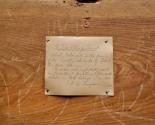
A 1771 inventory of Timothy Edwards’s estate noted a “Carvd Box” valued at one shilling. A 19th-century label nailed to the underside of the box’s lid also preserves its association with the Edwards family. In a flowing hand, the label’s inscription reads: “A Travelling Trunk / Which belonged to the family / of Rev. Timothy Edwards of East / Windsor, Conn. / It was not unprobably used / by President Jonathan Edwards / while in Yale College 1716–1820. / A. C. Thompson.” Timothy’s son Jonathan Edwards (1703–1758) matriculated at the Collegiate School (now Yale University) in 1716, not long before his thirteenth birthday. (The 1820 date on the label is almost certainly an error, with the writer intending 1720.) He went on to become one of colonial America’s most important preachers and theologians, a leading force in the First Great Awakening, and, very briefly, president of the College of New Jersey (now Princeton University) just before his death. Among his writings is the famous sermon “Sinners in the Hands of an Angry God.”
Perhaps less well known is that Jonathan Edwards was an enslaver, purchasing his first enslaved person, a young girl about fourteen years old whose name was recorded as “Venus,” in 1731. Slavery, though closely associated with the plantation economy of the South, was also firmly established and widespread in colonial New England. Timothy Edwards enslaved at least one person, and other prominent men in Jonathan Edwards’s community of Northampton, Massachusetts, were also enslavers. In 1741, colleagues called upon Edwards to defend a fellow minister, Benjamin Doolittle, against several complaints, one of them the enslavement of a man named Abijah Prince. Edwards’s notes on the subject survive, offering insight into the arguments and rationalizations that a highly educated man devoted to righteousness might nevertheless use to justify defending the cruelty of slavery.
A. C. Thompson, whose name appears on the label, was Augustus Charles Thompson (1812–1901). Educated at Yale and the Pastoral Union of Connecticut, Thompson served as a minister in Roxbury, Massachusetts, and as a lecturer and trustee of Hartford Theological Seminary. Research indicates that the box descended through the family of Timothy Edwards and his daughter Ann Edwards Ellsworth and subsequently passed into the Stoughton family, where it reportedly remained in the Ellsworth homestead until 1856. The box later passed through descendants including John Wetmore Stoughton and John Alden Stoughton (1848–1915), who described it in Windsor Farmes (1883). The circumstances of its transfer from the family remain unclear. It may have passed through Thompson’s hands or been transferred directly to the Connecticut Theological Institute at East Windsor (later Hartford Theological Seminary). By the late nineteenth century, however, it was in the seminary’s possession. Its ownership there until the late twentieth century was no doubt a major factor in the box’s preservation.
ProvenanceReverend Timothy Edwards (1669–1758), East Windsor, Connecticut, possibly acquired directly from the maker, Thomas Stoughton IV (1662–1748), c. 1695; by descent through Edwards’s daughter Ann Edwards Ellsworth (1699–1790) to her daughter Ann Ellsworth Stoughton (1741–1819), wife of Lemuel Stoughton (1740–1816); by descent in the Stoughton family, East Windsor, the box reportedly remaining in the Ellsworth homestead until 1856, probably passing then to John Wetmore Stoughton (1812–1899), and later to John Alden Stoughton (1848–1915), who described it in "Windsor Farmes" (1883); possibly transferred by a member of the Stoughton family to Rev. Augustus C. Thompson (1812–1901) or to the Connecticut Theological Institute, East Windsor, Connecticut (later Hartford Theological Seminary), by the mid-19th century; Hartford Theological Seminary, Hartford, Connecticut, by the late 19th century; acquired by Alice and Dr. Thomas P. Kugelman, Windsor, Connecticut, probably in connection with the seminary’s relocation in 1984; purchased by Constance (1929–2014) and Dudley Godfrey, Jr. (1926–2007), Milwaukee, Wisconsin, 2002; Constance P. Godfrey Living Trust; purchased by the Museum of Fine Arts, Houston, 2021.
Exhibition History“Woodworkers of Windsor: A Connecticut Community of Craftsmen and Their World, 1635–1715,” Historic Deerfield, Deerfield, Massachusetts, April 25–August 18, 2003 (cat. no. 24, p. 62).
Published References Lane, Joshua W. and Donald P. White III. "Fashioning Furniture and Framing Community: Woodworkers and the Rise of a Connecticut River Valley Town" in American Furniture 2005, figs. 66 and 67. Milwaukee, Wisconsin: Chipstone Foundation, 2005. Inscriptions, Signatures and Marks
Cataloguing data may change with further research.
If you have questions about this work of art or the MFAH Online Collection please contact us.