
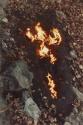
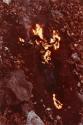
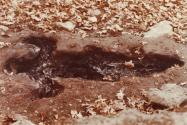
Alma, silueta en fuego
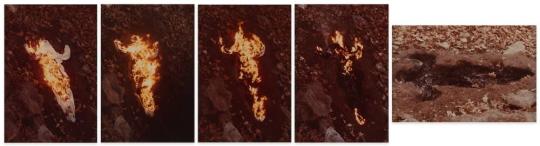
Artist
Ana Mendieta(American, born Cuba, 1948–1985)American, born Cuba, 1948–1985
CultureAmerican
Titles
- Alma, silueta en fuego
- Soul, Silhouette on Fire
Date1975
MediumChromogenic prints
DimensionsImage (Each): 10 × 8 in. (25.4 × 20.3 cm)
Sheet (Each): 10 × 8 in. (25.4 × 20.3 cm)
Sheet (Each): 10 × 8 in. (25.4 × 20.3 cm)
Credit LineMuseum purchase funded by the Caroline Wiess Law Accessions Endowment
Object number2020.507.A-.E
Not on view
Explore Further
Department
Latin American ArtObject Type
Published References The Silueta series has been featured in the following publications: Best, Susan. “The Serial Spaces of Ana Mendieta.” Art History 30, no. 1 (2007): 57-82. Cabañas, Kaira M. "Ana Mendieta: "Pain of Cuba, Body I Am." In Woman's Art Journal 20, no. 1 (1999): 12-17. Gray, Frances. Jung, Irigaray, Individuation: Philosophy, Analytical Psychology, and the Questions of the Feminine. New York: Routledge, 2008. Grosz, Elizabeth. “Conclusion: A Note on Essentialism and Difference.” In Feminist Knowledge: Critique and Construct, edited by Sneja Marina Gunew, 332-343. London: Routledge, 1990. Herzberg, Julia P. “Ana Mendieta’s Iowa Years: 1970-1980.” In Ana Mendieta: Earth Body: Sculpture and Performance, 1972-1985, edited by Olga M. Viso, 136-179. Washington, D.C.: Hirshhorn Museum and Sculpture Garden, Smithsonian Institution, 2004. Iles, Chrissie. “Subtle Bodies: The Invisible Films of Ana Mendieta.” In Ana Mendieta: Earth Body: Sculpture and Performance, 1972-1985, edited by Olga M. Viso, 204-221. Washington, D.C.: Hirshhorn Museum and Sculpture Garden, Smithsonian Institution, 2004. Irele, F. Abiola, and Biodun Jeyifo, eds. Lippard, Lucy. Overlay: Contemporary Art and the Art of Prehistory. New York: Pantheon Books, 1983. Montano, Linda. The Performance Bible, unpublished interviews with 155 artists. Courtesy of the Estate of Ana Mendieta and Galerie Lelong, New York City. Neumann, Erich. The Great Mother. Princeton NJ: Princeton University Press, 1963. Orenstein, Gloria Feman. “Recovering Her Story: Feminist Artists Reclaim the Great Goddess.” The Power of Feminist Art, The American Movement of the 1970s, History and Impact, edited by Norma Broude and Mary D. Garrard, 174-189. New York: Harry N. Abrams, 1994. Raine, Anne. “Embodied Geographies: Subjectivity and Materiality in the Work of Ana Mendieta.” In Generations and Geographies in the V Visual Arts: Feminist Readings, edited by Griselda Pollock, 228-249. New York: Routledge, 1990. Scott, Joan W. "Gender: A Useful Category of Historical Analysis." The American Historical Review 91, no. 5 (1986): 1053-075. Spero, Nancy. “Tracing Ana Mendieta.” In Artforum 30, no. 8 (1992): 75-77. Viso, Olga M. “The Memory of History.” In Ana Mendieta: Earth Body: Sculpture and Performance, 1972-1985, edited by Olga M. Viso, 35-135. Washington, D.C.: Hirshhorn Museum and Sculpture Garden, Smithsonian Institution, 2004
Cataloguing data may change with further research.
If you have questions about this work of art or the MFAH Online Collection please contact us.
Unknown Central and South American
c. 1000–500 BC
Greenstone
2023.232

Ando Hiroshige
about 1833–1834 (Tempo 4–5)
Woodblock print; ink and color on paper
2008.436

Unknown
c. late 18th - early 19th century
Leather, porcupine quills, glass beads, silk, and sinew
2025.767.A,.B


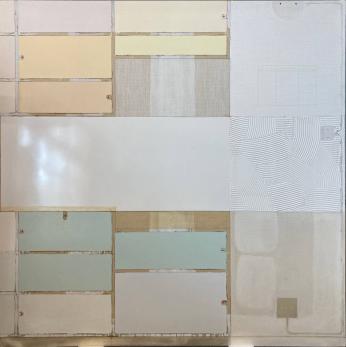
Clay Ketter
1997
Household enamel paint, net wall covering, plastic laminate, wallboard compound and steel corner bead on gypsum wallboard, wood frame
2024.306