Tankard
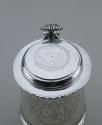
- Tankard
Explore Further
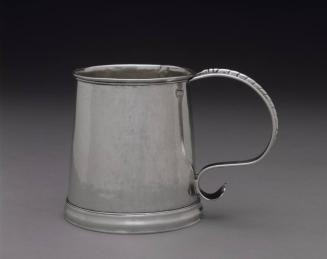
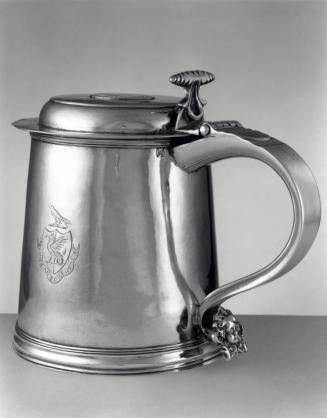
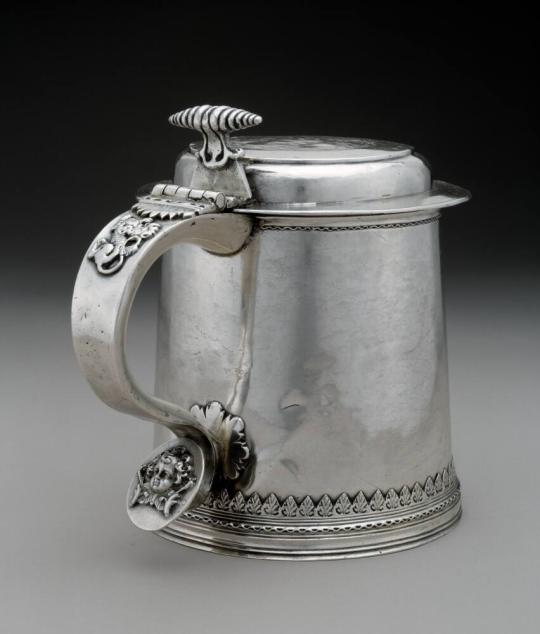
The New York tankard manifests one of the rare instances in American decorative arts when two distinct cultures merge. This event occurred in 1664 when the Dutch colony of New Amsterdam was taken over by the British, who promptly renamed it New York. While the two peacefully coexisted, the Dutch ardently strove to preserve their native language and culture, succeeding in this effort into the nineteenth century.
Traditionally, the tankard is an English form and not one associated with Holland. Conversely, the profusion of engraved, chased, and cast ornament that adorns Netherlandish and New York silver is rarely encountered in English work. Elements characteristic of Early Baroque New York tankards are the handle's cast lion couchant, the cherub’s-head terminal, the double-spiral thumbpiece, and the expertly engraved arms and surround. The cut-card bands that ornament the base molding are unique from shop to shop. The Bayou Bend tankard, notable for its generous size and richly executed decoration, is one of the most splendid expressions of this type.
Related examples: Eight tankards from Van Dyck's shop are recorded. Those in public collections include Buhler and Hood 1970, vol. 2, pp. 39–41, 51, nos. 587, 596; Puig et al. 1989, pp. 228–29, no. 187: PMA (acc. no. 51–103–1). Examples with similarly engraved lids include Avery 1920, pp. 17–20, no. 9; Hyde 1971, pp. 176–77, no. 402.
Book excerpt: David B. Warren, Michael K. Brown, Elizabeth Ann Coleman, and Emily Ballew Neff. American Decorative Arts and Paintings in the Bayou Bend Collection. Houston: Princeton Univ. Press, 1998.
ProvenanceThomas Gibbs (1671–1716) and Sarah Gibbs, Southampton (1672–1748), Bermuda; inherited by their son George Gibbs (d. 1772); inherited by his daughter Miriam Gibbs Saltus (1757–1851); inherited by her son Samuel Saltus (d. 1880); inherited by his cousin George Judson Gibbs (1833–1899); inherited by his son George Albert St. George Gibbs (1866–1938); inherited by his cousin Ralph Gibbs Whedon (1891–1967); [Ginsburg & Levy, New York, c. 1946]; purchased by Richard A. Loeb, New Jersey; sold through [Ginsburg & Levy, New York, 1953]; purchased by Miss Ima Hogg, 1953; given to MFAH, 1969.
Published References Correspondence between Samuel Saltus and (probably) George Gibbs, November 22, 1847, and August 25, 1848 (copies in object files); The Magazine Antiques 50 (November 1946), p. 300; The Magazine Antiques 90 (December 1966), p. 803; Warren, David B. "A Great Texas Collection of Americana: The Bayou Bend Collection at the Museum of Fine Arts, Houston." The Connoisseur 178 (September 1971), p. 52, no. 26; Warren, David B. Bayou Bend: American Furniture, Paintings and Silver from the Bayou Bend Collection. Houston: Museum of Fine Arts, Houston; Boston: New York Graphic Society, 1975, p. 154, no. 287. Inscriptions, Signatures and Marks
Engraved on side: a pouncing griffin, the crest of the Rich family, from whom Thomas Gibbs was descended
Engraved on lid: a merchant ship
Cataloguing data may change with further research.
If you have questions about this work of art or the MFAH Online Collection please contact us.