Dressing Table
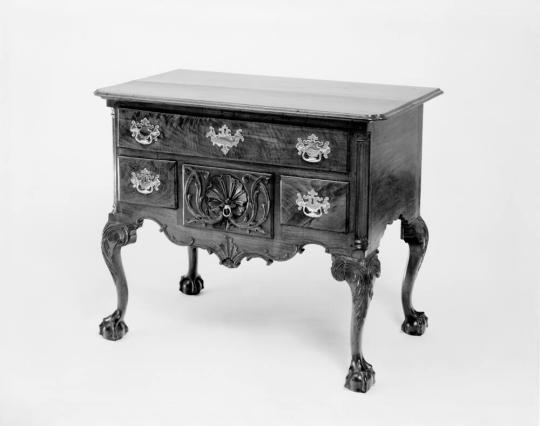
- Dressing Table
Explore Further
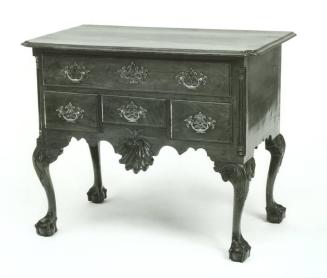
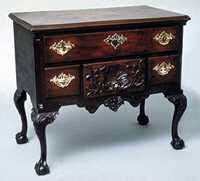
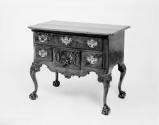
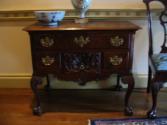
The 1772 and 1786 Philadelphia price lists specify, for the majority of forms recorded, two price scales depending on whether the object was fashioned of imported mahogany or indigenous black walnut, the difference being 25 to 40 percent greater for the former. Not only was mahogany the more stylish, it was also preferred, being easier to work, worm-resistant, and less likely to warp or crack. On occasion black walnut was substituted, presumably for reasons of economy. The Bayou Bend dressing table, with its well-executed ornament and figured facade, belongs to a small group of richly carved Philadelphia furniture crafted of native wood.
Book excerpt: Warren, David B., Michael K. Brown, Elizabeth Ann Coleman, and Emily Ballew Neff. American Decorative Arts and Paintings in the Bayou Bend Collection. Houston: Princeton Univ. Press, 1998.
Provenance[William MacPherson Hornor (1897–1969), Philadelphia] who advertised its descent in Percival, Zantzinger, and Helmuth families of Philadelphia; [David Stockwell (1907–1996), Wilmington, Delaware]; purchased by Miss Ima Hogg, 1948; given to MFAH, 1969.
Published References Antiques 52 (September 1947), p. 168; The Magazine Antiques 54 (October 1948), p. 220; Warren, David B. Bayou Bend: American Furniture, Paintings and Silver from the Bayou Bend Collection. Houston: Museum of Fine Arts, Houston; Boston: New York Graphic Society, 1975, p. 61, no. 118; Monkhouse, Christopher P., and Thomas S. Michie. American Furniture in Pendleton House. Providence: Rhode Island School of Design, Museum of Art, 1986, pp. 80–81, no. 26; Sack, Harold, and Max Wilk. American Treasure Hunt, The Legacy of Israel Sack. Boston: Little, Brown, and Co., 1986, p. 178. Inscriptions, Signatures and Marks
Cataloguing data may change with further research.
If you have questions about this work of art or the MFAH Online Collection please contact us.