Card Table
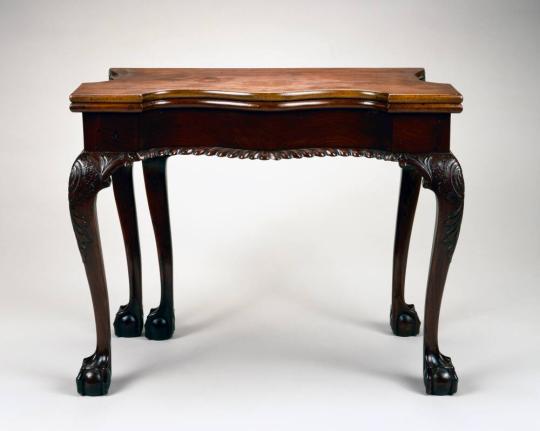
- Card Table
Closed: 27 5/8 × 34 3/4 × 17 1/2 in. (70.1 × 88.3 × 44.5 cm)
Explore Further
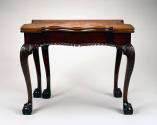
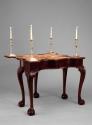
Serpentine-front card tables are the most original and dynamic Rococo furniture forms produced in New York. The design, which appears to have originated there, is characterized by its serpentine facade and the addition of a fifth leg that pivots outward to support the opened top. The knees are ornamented with either a carved leaf or C-scroll design, and the front rail with gadrooning or foliate carving. Typically, the top is cut out for a baize liner, coins and counters, and to accommodate a candlestick at each corner. More than seventy-five examples are recorded, representing several distinct shop traditions; the only one identified is that of Marinus Willett and Jonathan Pearsee, to which the Bayou Bend table is attributed.
Related examples: Morrison Heckscher’s initial study (Heckscher 1973) classifies the Bayou Bend table as Type I, the Van Rensselaer, Group B. Nine other tables are recorded: Monkhouse and Michie 1986, p. 139, no. 77; Barquist, Garrett, and Ward 1992, pp. 46, 167–69, no. 74; Levy 1993, pp. 760–61; one belonging to the Nelson-Atkins Museum of Art, Kansas City, Missouri (acc. no. 44–12); the remainder in private collections, one with the chalk signature “Willet.”
Book excerpt: Warren, David B., Michael K. Brown, Elizabeth Ann Coleman, and Emily Ballew Neff. American Decorative Arts and Paintings in the Bayou Bend Collection. Houston: Princeton Univ. Press, 1998.
ProvenanceLouis Guerineau Myers (1874–1932), New York; consigned to [American Art Association, Anderson Galleries, New York, February 26, 1921, lot 672]; [Joe Kindig, Jr. (1898–1971), York, Pennsylvania]; purchased by Miss Ima Hogg, 1949; given to MFAH, 1969.
Published References The American Art Association, New York, February 24–26, 1921, lot 672; Heckscher, Morrison H. “The New York Serpentine Card Table.” The Magazine Antiques 103 (May 1973), p. 983; Warren, David B. Bayou Bend: American Furniture, Paintings and Silver from the Bayou Bend Collection. Houston: Museum of Fine Arts, Houston; Boston: New York Graphic Society, 1975, p. 58, no. 109; Greenlaw, Barry A. “Ornamental and Plain: American Card Tables in the Bayou Bend Collection.” Theta Charity Antique Show Catalogue. Houston, 1978, p. 15; Barquist, David L., Elisabeth Donaghy Garrett, and Gerald W. R. Ward. American Tables and Looking Glasses in the Mabel Brady Garvan and Other Collections at Yale University. New Haven: Yale University Art Gallery, 1992, p. 169; Levy, Frank M. “A Maker of New York Card Tables Identified.” The Magazine Antiques 143 (May 1993), pp. 756, 758, 761. Inscriptions, Signatures and Marks
Stamped beneath gadrooning: [---]4405
Cataloguing data may change with further research.
If you have questions about this work of art or the MFAH Online Collection please contact us.