Armchair

- Armchair
Explore Further
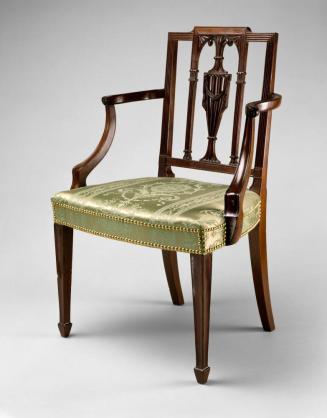
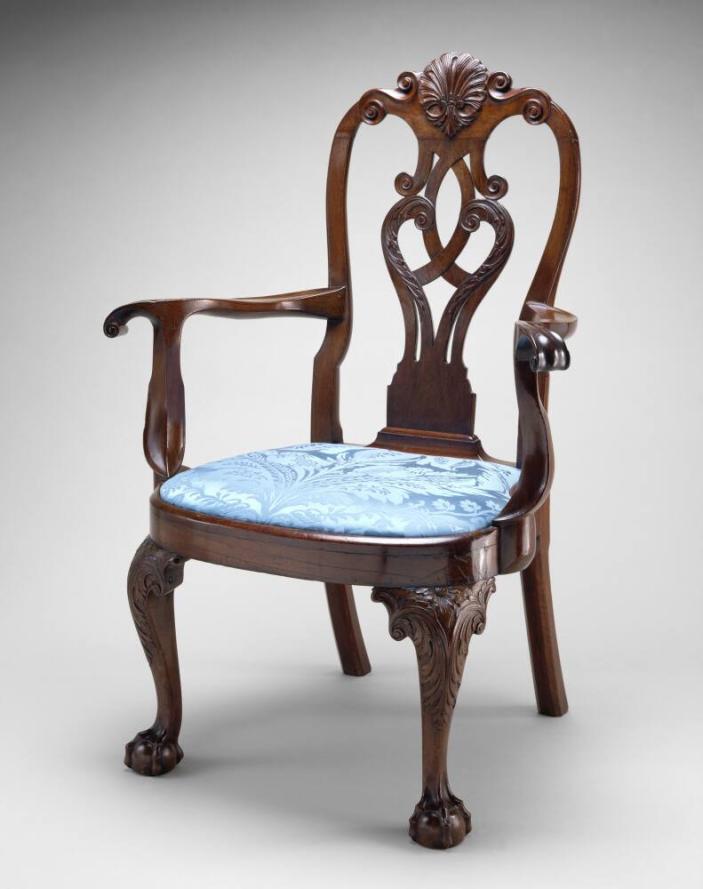
This masterful armchair reflects the maturity of the Late Baroque yet, with its carved acanthus knees, foliate, strapwork banister, and naturalistic shell topping the crest rail, it is fully conversant with Rococo taste. This unusual configuration may represent the brief period of transition between the Late Baroque and Rococo, or perhaps it is a design that never realized widespread popularity.
Technical notes: Mahogany; eastern white pine (slip seat). The interior front seat rail is bowed and its lip is applied. The seat rails are tenoned through the stiles. The rear seat rail is not nearly as deep as the shoe. The inside of the front and rear seat rails is carved I. An illegible inscription is on the slip seat frame. Luke Beckerdite comments that the carving imitates the body of the work he has assigned to the same hand that carved the great Philadelphia high chest in the Garvan Collection at Yale (Ward 1988, pp. 280–83, no. 147), referring to the unknown craftsman as the “Garvan carver.”
Related examples: Most closely related is Heckscher 1985, pp. 90–92, no. 45. A side chair with related carving is in Downs 1952, no. 115. Wallace Nutting offered a reproduction of this armchair in Antiques 36 (November 1939), p. 214.
Book excerpt: David B. Warren, Michael K. Brown, Elizabeth Ann Coleman, and Emily Ballew Neff. American Decorative Arts and Paintings in the Bayou Bend Collection. Houston: Princeton Univ. Press, 1998.
Provenance[Ginsburg & Levy, New York, by 1954]; purchased by Miss Ima Hogg, July 21, 1954; given to MFAH, by 1969.
Exhibition History
Published References The Magazine Antiques 41 (April 1942), p. 234; A Century of American Chairs: 1720−1820, exh. cat. New York: Ginsburg and Levy, 1942, no. 7; Connoisseur 133 (May 1954), p. 195; The Magazine Antiques 66 (August 1954), p. 87; Ramsey, L.G.G., ed. The Concise Encyclopedia of Antiques, 5 vols. New York: Hawthorn Books, 1954, vol. 1, pl. 39B; Comstock, Helen. American Furniture, Seventeenth, Eighteenth, and Nineteenth Century Styles. New York: Viking Press, 1962, no, 149; Warren, David B. ‘‘American Decorative Arts in Texas: The Bayou Bend Collection of the Museum of Fine Arts of Houston.” The Magazine Antiques 90 (December 1966), p. 805; Warren, David B. “A Great Texas Collection of Americana: The Bayou Bend Collection at the Museum of Fine Arts, Houston.” The Connoisseur 178 (September 1971), p. 42, no. 10; Warren, David B. Bayou Bend: American Furniture, Paintings and Silver from the Bayou Bend Collection. Houston: Museum of Fine Arts, Houston; Boston: New York Graphic Society, 1975, p. 27, no. 49; Warren, David B. Bayou Bend: The Interiors and the Gardens. Houston: Museum of Fine Arts, Houston, 1988, pp. 26−27; Marzio, Peter C., et al. A Permanent Legacy: 150 Works from the Collection of the Museum of Fine Arts, Houston. Houston: Museum of Fine Arts, Houston, 1989, pp. 236–37. Inscriptions, Signatures and Marks
Cataloguing data may change with further research.
If you have questions about this work of art or the MFAH Online Collection please contact us.