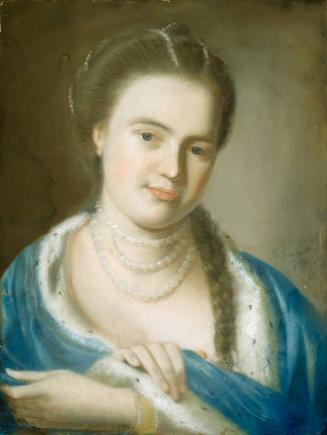
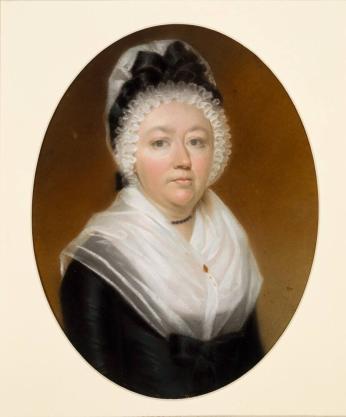
Portrait of Sarah Henshaw (Mrs. Joseph Henshaw, 1736–1822)
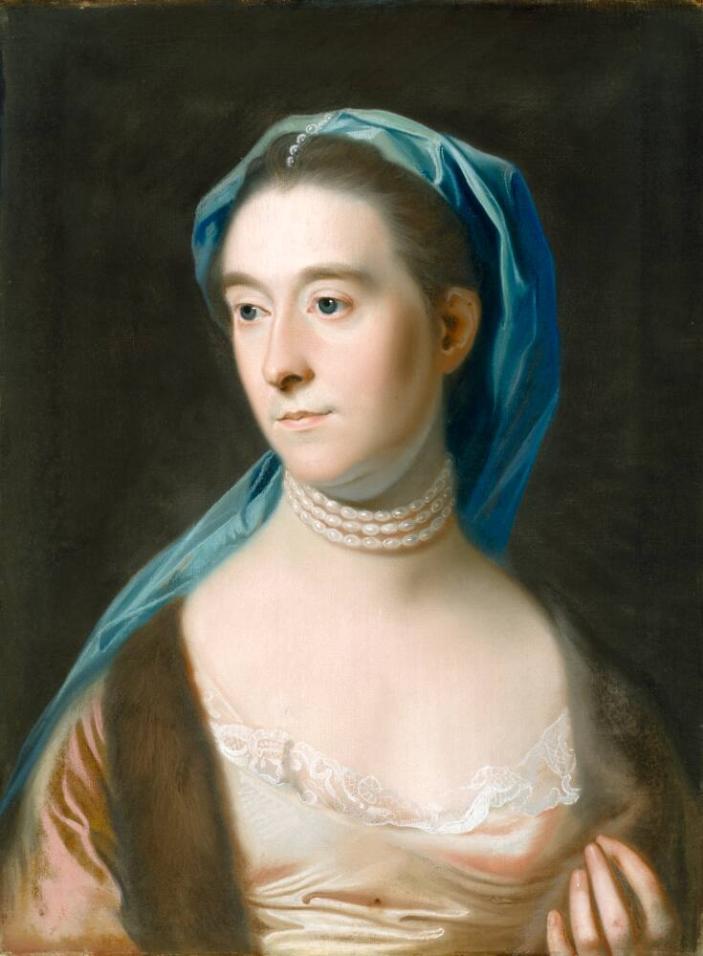
- Portrait of Sarah Henshaw (Mrs. Joseph Henshaw, 1736–1822)
Explore Further
Over the years, Copley’s technique in pastel became more sophisticated. The greater availability of ready-made pastel sticks in a vast array of tones allowed the artist to apply and blend strokes of individual shades so that the general effect was one of subtle modulation rather than sharp contrasts between light and dark, as seen in such earlier pastels as the Portrait of Elizabeth Byles (Mrs. Gawen Brown, 1737–1763)
(see B.54.21). This more refined technique, which heightened the plasticity and realism of the sitter’s form and props, is demonstrated in the portrait of Mrs. Henshaw, among the last pastels Copley produced. The uncorseted salmon-colored gown trimmed with brilliant white lace and bordered by brown fur, the velvet texture of the pearl-trimmed headdress, and the silvery luster of the necklace appear especially vivid, setting off the creamy quality of the sitter’s skin.
Copley may have borrowed the pose for this portrait from a c. 1770 allegorical print, Catherine McCaulay, in the Character of a Roman Matron Lamenting the Lost Liberties of Rome, circulating in the London Magazine of July 1770. The pose and headdress are, indeed, similar, although in the engraving the sitter holds a scroll. The specific gesture of clasping a mantle or garment, which Copley used five years earlier, perhaps derived from mezzotints of portraits by Sir Anthony Van Dyck or Sir Peter Lely, where it is used, for both male and female sitters, to suggest elegance and grace.
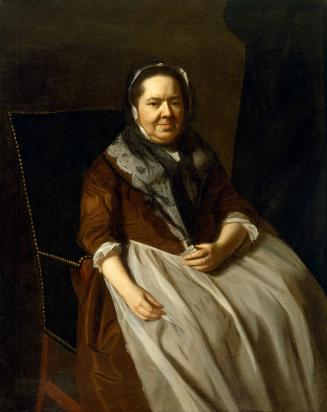
Sarah Henshaw (1736–1822) married her cousin Joseph Henshaw in 1758. From a wealthy mercantile family in Boston, Joseph graduated from Harvard before entering the shipping business himself. His first frigate was named for his fiancé. After they married, they lived first in Boston, then in Leicester, by 1773, and, following the Revolutionary War, in Shrewsbury. Sarah, who bore no children, was a brilliant needleworker, leaving behind an elegant family coat of arms (private collection) as well as an elaborate history piece, The Death of Absalom (MFA, Boston).
Related examples: Copley painted several members of the Henshaw family: Sarah’s father, Joshua Henshaw, c. 1770, Fine Arts Museum of San Francisco; her brother Joshua Henshaw, Jr., and his wife, Mrs. Joshua Henshaw, Jr., c. 1770–74, private collection, unsold at Christie’s, New York, sale 5108, December 11, 1981; and Sarah’s husband, her cousin Joseph Henshaw, 1727–1794, private collection. Her hand gesture, in which her fingers delicately clasp her fur tippet, is also seen in Copley’s pastel portraits of Jonathan Jackson, c. 1767–69, MFA, Boston; Joseph Barrell, c. 1767–69, Worcester Art Museum, Worcester, Massachusetts; Mrs. Elijah Vose, c. 1770–72, Hirschl and Adler Galleries, New York: and Mrs. Henry Hill, c. 1770, Art Institute of Chicago; and is similar to the oil portraits of Mrs. Joseph Scott, c. 1765, Newark Museum, Newark, New Jersey; and Mrs. Henderson Inches, c. 1765, The Huntington Library, Art Collections and Botanical Gardens, San Marino, California.
Book excerpt: David B. Warren, Michael K. Brown, Elizabeth Ann Coleman, and Emily Ballew Neff. American Decorative Arts and Paintings in the Bayou Bend Collection. Houston: Princeton Univ. Press, 1998.
ProvenanceThe sitter Mrs. Joseph Henshaw (Sarah Henshaw, 1736–1822); descended to her great grand-nephew Dr. J. McLean Hayward; descended to Sidney W. Hayward, Wayland, Massachusetts, until c. 1936; descended to Herbert Lawton, Boston, until 1937; consigned to [American Art Association, Anderson Galleries, New York, The American Collection of Herbert Lawton, April 2–3, 1937, lot 345]; purchased by Alice (née Gardner Burnell, 1873–1954) and Luke Vincent Lockwood (1872–1951), Greenwich, Connecticut, until 1954; consigned to [Parke-Bernet, New York, Seventeenth-Eighteenth Century American Furniture and Paintings, The Celebrated Collection formed by the Late Mr. and Mrs. Luke Vincent Lockwood, May 13–15, 1954, lot 453]; purchased by Miss Ima Hogg, 1954; given to MFAH, by 1966.
Exhibition HistoryMuseum of Fine Arts, Boston, 1919.
"John Singleton Copley, 1738–1815," Museum of Fine Arts, Boston, February 1–March 15, 1938.
"John Singleton Copley in America," Museum of Fine Arts, Houston, February 4–April 28, 1996.
"American Made: 250 Years of American Art at the Museum of Fine Arts, Houston," Museum of Fine Arts, Houston, July 7, 2012–January 2, 2013.
"Radicals and Revolutionaries: America's Founding Fathers," Museum of Fine Arts, Houston, March 10–May 28, 2018.
Published References Perkins, Augustus Thorndike. Sketch of the Life and a List of Some of the Works of John Singleton Copley. Boston: James R. Osgood and Co., 1873, p. 71; Bayley, Frank W. The Life and Works of John Singleton Copley. Boston: Taylor Press, 1915, p. 142; Bolton 1923, no. 28; Parker and Wheeler 1938, p. 225, pl. 126; Winchester 1961a, pp. 22–23; Winchester 1961b, p. 237; Prown, Jules D. John Singleton Copley. 2 vols. Cambridge: Harvard University Press for the National Gallery of Art, 1966, vol. 1, p. 67, no. 238; Warren, David B. ''American Decorative Arts in Texas: The Bayou Bend Collection of The Museum of Fine Arts of Houston." The Magazine Antiques 90 (December 1966), p. 804; Warren, David B. "A Great Texas Collection of Americana: The Bayou Bend Collection at the Museum of Fine Arts, Houston." The Connoisseur 178 (September 1971), p. 41; House and Garden 1973, p. 92; Warren, David B. Bayou Bend: American Furniture, Paintings and Silver from the Bayou Bend Collection. Houston: Museum of Fine Arts, Houston; Boston: New York Graphic Society, 1975, p. 134, no. 251; Cooper, Wendy A. In Praise of America: American Decorative Arts, 1650–1830. New York: Alfred A. Knopf, 1980, p. 190; Warren, David B. "Ima Hogg, Collector." The Magazine Antiques 121 (January 1982), pp. 231, 233; Ring, Betty. Girlhood Embroidery: American Samplers & Pictorial Needlework 1650−1850. 2 vols. New York: Alfred A. Knopf, 1993, vol. 1, p. 56. Inscriptions, Signatures and Marks
Cataloguing data may change with further research.
If you have questions about this work of art or the MFAH Online Collection please contact us.