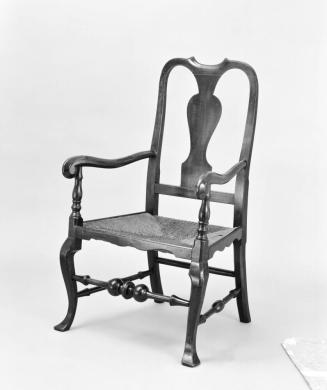
Easy Chair
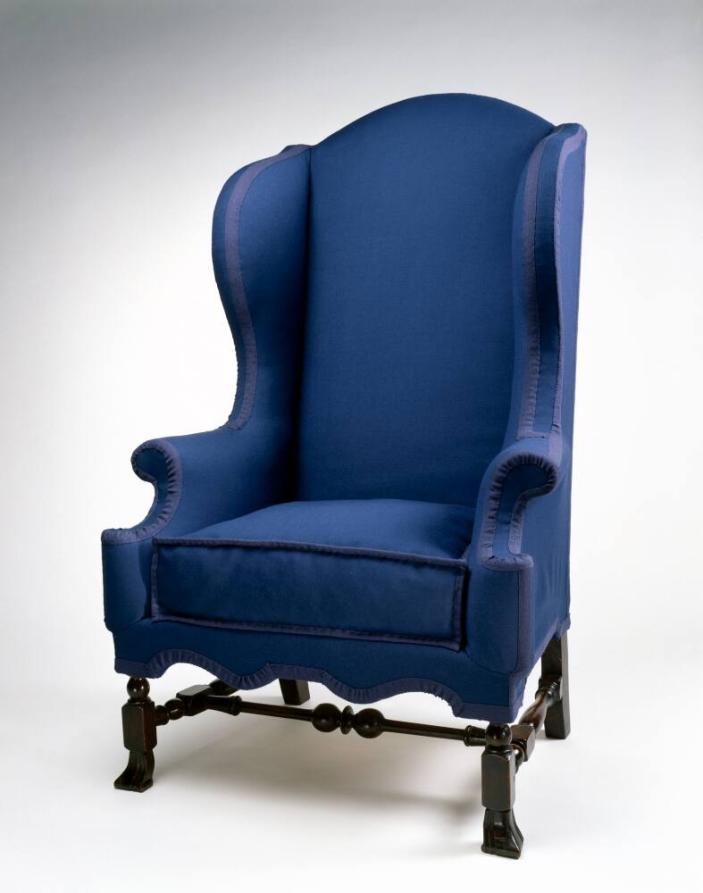
- Easy Chair
Explore Further
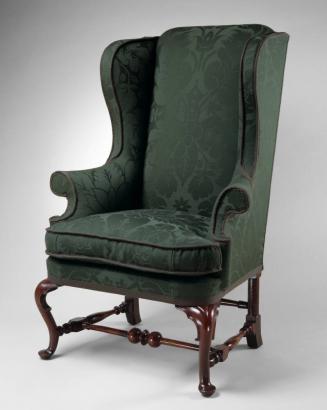
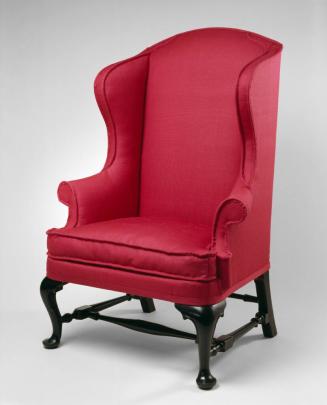
In the first decade of the eighteenth century, a new luxurious upholstered form, the easy chair, was introduced in America. Large wings that attach to the back and afford the sitter, usually someone old or ill, protection from cold and drafts characterize the type. Padding on the interior of the wings and deep, down-filled cushions provided added comfort. Intended as a piece of bedroom furniture, the easy chair was also occasionally fitted out as a commode or pot chair. The double-scroll arms with C-shaped panels are common to models produced before the late 1730s. The Bayou Bend chair is unusual in several features. It combines the bold Baroque scalloped skirt and block-and-vase turned front legs, elements of the early type of easy chair, with a tripartite ball-and-ring medial stretcher, which replaced the earlier multiple vase-and-ring turned stretchers. Unlike the earlier type, the ball-and-ring stretcher was located not centrally but closer to the front legs and attached to blocks on long, vase-shaped side stretchers. While typically those later chairs with the ball-and-ring stretcher have nascent cabriole legs, or crookt feet (see B.69.223), this example uses the earlier turned format.
Technical notes: Soft maple (front, rear, and right seat rail, stay rail, right S wing, front and right stretcher, right stile, right arm support, filler block in front of right arm support), eastern white pine (left front corner block, right top corner block, interior right arm), hard maple (right front leg), birch (exterior right arm). At some point during the eighteenth century, as witnessed by the use of wrought nails, the chair’s upper frame was modified: the upper horizontal members of the wings and the crest rail were replaced and the fronts of the wings had pieces added just above the arm to make them deeper and more vertical. These alterations may have been an attempt to update the chair by creating a simple arched crest and deeper, forward sloping wings. The Spanish feet are original and made of several pieces glued together; the rear stretcher lacks the central ball-and-ring turning and simply swells at the center. The rear legs have lost about two inches in height. The shape of the upholstery and loss of back legs was corrected by conservation in 1996.
Related examples: An easy chair at MMA, with similar front legs and small Spanish feet but with an early multiple-vase turned stretcher, demonstrates what the Bayou Bend example may have looked like before the alteration of its wings and crest (Davidson and Stillinger 1985, p. 109, fig. 142); Winterthur, two early types with similar scalloped skirt (Forman 1988, nos. 87, 88) and three later types with ball-and-ring stretcher and cabriole legs (Forman 1988, nos. 90–92); MFA, Boston, an early scalloped-skirt type (Fairbanks et al. 1981, p. 595, pl. VII); Williamsburg, formerly in the Blagojevich Collection, an early example (Winchester 1963, p. 134); Sotheby Parke Bernet, New York, sale 4116, April 27-29, 1978, lot 920, a turned-leg, Spanish-foot example with ball-and-ring stretcher.
Book excerpt: David B. Warren, Michael K. Brown, Elizabeth Ann Coleman, and Emily Ballew Neff. American Decorative Arts and Paintings in the Bayou Bend Collection. Houston: Princeton Univ. Press, 1998.
ProvenanceTheophilus Parsons (1750–1813), Ipswich, Massachusetts; by descent to J. Lewis Stackpole, Boston (d. 1953); [John Kenneth Byard (1905–1960), Silvermine, Norwalk, Connecticut, probably by 1949]; [Israel Sack, New York]; purchased by Miss Ima Hogg, September 29, 1958; given to MFAH, by 1966.
Published References Advertisement of Israel Sack, Inc., inside front cover. The Magazine Antiques 73 (June 1958); Advertisement of John Kenneth Byard. The Magazine Antiques 57 (June 1950), p. 401; Bishop, Robert. How to Know American Antique Furniture, p. 31. New York: E. P. Dutton and Co., 1973; Comstock, Helen. American Furniture, Seventeenth, Eighteenth, and Nineteenth Century Styles, no. 44. New York: Viking Press, 1962; Naeve, Milo M. Identifying American Furniture: A Pictorial Guide to Styles and Terms, Colonial to Contemporary, p. 18, no. 19. Nashville: American Association for State and Local History, 1981; Sack, Albert. Fine Points of Furniture: Early American, p. 64. New York: Crown Publishers, 1950; Warren, David B. “A Great Texas Collection of Americana: The Bayou Bend Collection at the Museum of Fine Arts, Houston,” p. 41, fig. 7; The Connoisseur 178 (September 1971); Warren, David B. “American Decorative Arts in Texas: The Bayou Bend Collection of the Museum of Fine Arts of Houston,” p. 808. The Magazine Antiques 90 (December 1966); Warren, David B. Bayou Bend: American Furniture, Paintings and Silver from the Bayou Bend Collection, p. 11, no. 17. Houston: Museum of Fine Arts, Houston; Boston: New York Graphic Society, 1975. Inscriptions, Signatures and Marks
Cataloguing data may change with further research.
If you have questions about this work of art or the MFAH Online Collection please contact us.