Tankard
- Tankard
Explore Further
John Coney is arguably the greatest of all colonial American silversmiths. His shop is recognized as the first in this country to have produced several forms, including the inkstand, fork, sugar box, chafing dish, monteith, and chocolate pot, and the earliest New England teapot. Coney was equally adept as an engraver, executing the plates for some early paper currency for Massachusetts and New Hampshire.
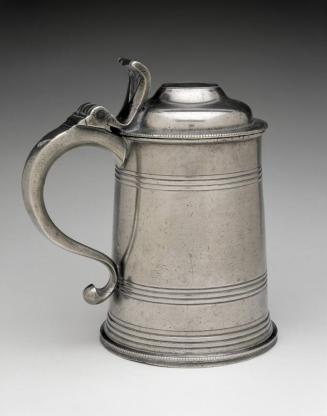
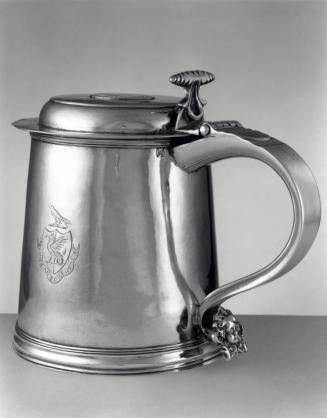
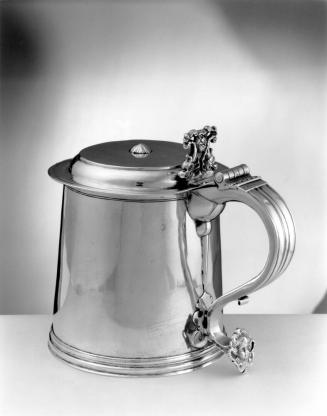
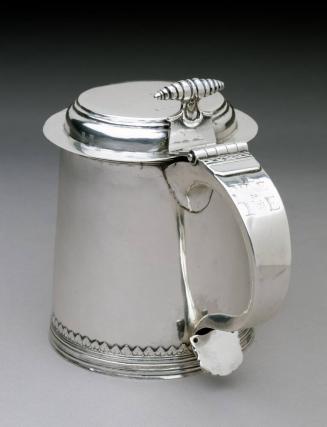
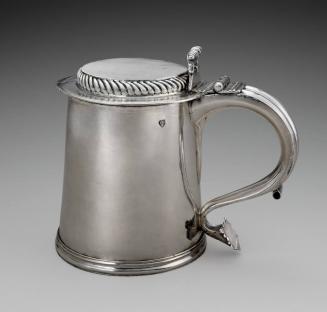
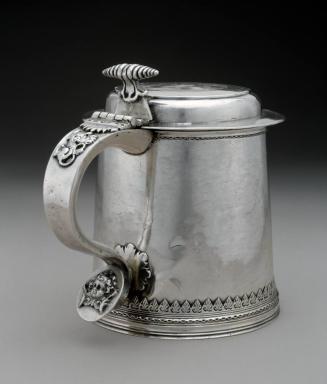
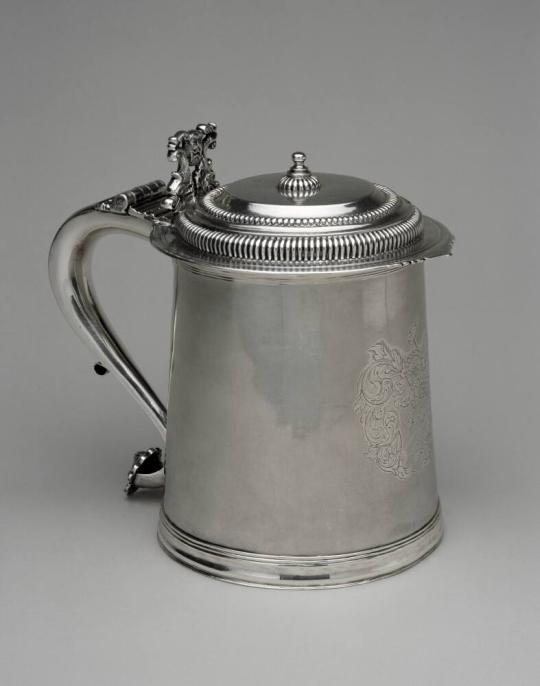
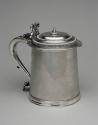
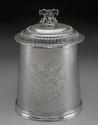
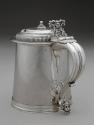
The Bayou Bend tankard is a consummate American expression of Early Baroque silver. It is outstanding for its unusual tiered and reeded lid. It is endowed with a sense of dynamic movement to which only one other piece of American silver from this period corresponds; Coney’s great two-handled covered cup that Massachusetts Lieutenant-Governor William Stoughton presented to Harvard College in 1701. The tankard was made for John Foster, a prosperous Boston merchant and prominent official. Foster was clearly a man with sophisticated taste and lofty aspirations. In 1692 he erected in Boston an extraordinary house that is credited with introducing New Englanders to the Italian Renaissance style. Foster’s tankard, like his mansion, is one of the most eloquent statements of style in early New England.
Technical notes: Below the handle's juncture with the lip is a boldly executed body drop, and at the base is a graceful cut card. The bezel has been removed.
Related examples: The Bayou Bend tankard is most like Buhler 1979, pp. 12–13, no. 3. Four similarly lidded Coney tankards belong to the First Parish, Cambridge (Jones 1913, pp. 107–8, pl. XLII).
Book excerpt: David B. Warren, Michael K. Brown, Elizabeth Ann Coleman, and Emily Ballew Neff. American Decorative Arts and Paintings in the Bayou Bend Collection. Houston: Princeton Univ. Press, 1998.
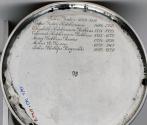
ProvenanceJohn Foster (1644–1710/11), Boston; given to his daughter Lydia (Mrs. Edward Hutchinson, 1686–1748); given to her daughter Elizabeth (Mrs. Nathaniel Robbins, 1731–1793); given to her son Edward Hutchinson Robbins (1758–1829); given to his daughter Mary (Mrs. Joseph Warren Revere, 1794–1879); given to her daughter Maria A. Revere (1828–1905); given to her nephew John Phillips Reynolds (1863–1920); given to his wife Lucretia R. Reynolds; given to her husband’s grandnephew Edward Reynolds, Jr.; [Firestone and Parson, Boston], purchased by Miss Ima Hogg, 1974; given to MFAH, 1974.
Exhibition History"The Family," The Museum of Fine Arts, Houston, May 29–August 6, 1989
"American Made: 250 Years of American Art at the Museum of Fine Arts, Houston," The Museum of Fine Arts, Houston, July 7, 2012–January 2, 2013
Published References Exhibition of Silversmithing by John Coney, 1655−1732. Exh. cat. Boston: Museum of Fine Arts, Boston, 1932, no. 36; Harvard Tercentenary Exhibition Catalogue of Furniture, Silver; Pewter, Glass, Ceramics, Paintings, Prints, Together with Allied Arts and Crafts of the Period 1636−1836. Cambridge: Harvard University Press, 1936, p. 27, no. 98; Flynt, Henry N., and Martha Gandy Fales. The Heritage Foundation Collection of Silver with Biographical Sketches of New England Silversmiths, 1625−1825. Old Deerfield, Mass.: Heritage Foundation, 1968, p. 114; Clarke, Hermann Frederick. John Coney Silversmith, 1655−1722. Boston: Houghton Mifflin, 1932. Reprint, New York: Da Capo Press, 1971, p. 36, no. 97, pl. XXVII; Buhler, Kathryn C. American Silver 1655−1825 in the Museum of Fine Arts, Boston. 2 vols. Boston: Museum of Fine Arts, Boston, 1972, vol. 1, p. 52; Cooper, Wendy A. In Praise of America: American Decorative Arts, 1650−1830. New York: Alfred A. Knopf, 1980, pp. 164–65, 171; Agee, William C., et al. The Museum of Fine Arts, Houston: A Guide to the Collection. Houston: Museum of Fine Arts, Houston, 1981, pp. 64–65; Warren, David B. "Ima Hogg, Collector." The Magazine Antiques 121 (January 1982), pp. 241, 243; Brown, Michael K. "A Tankard by John Coney." The Museum of Fine Arts, Houston Bulletin, n.s., 8, no. 2 (Winter 1983).; Marzio, Peter C., et al. A Permanent Legacy: 150 Works from the Collection of the Museum of Fine Arts, Houston. Houston: Museum of Fine Arts, Houston, 1989, pp. 228–29; Kane, Patricia E., ed. Colonial Massachusetts Silversmiths and Jewelers: A Biographical Dictionary Based on the Notes of Francis Hill Bigelow and John Marshall Phillips. New Haven: Yale University Art Gallery, 1998, p. 331. Inscriptions, Signatures and Marks
Engraved on base: the tankard's provenance [recorded about 1920, presumably for Mrs. John Phillips Reynolds]
Cataloguing data may change with further research.
If you have questions about this work of art or the MFAH Online Collection please contact us.