Barber's Bowl


- Barber's Bowl
Explore Further
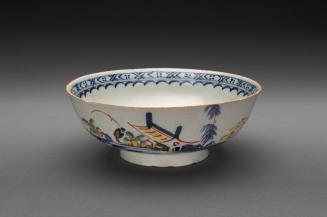
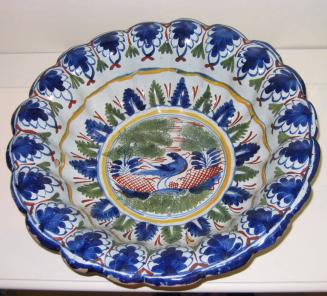
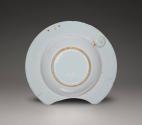
This English delftware barber’s, or shaving, bowl is round, with a curved basin and a wide rim. The rim includes a small round hollow for holding a soap ball and a semicircular opening. During shaving, the customer would rest this opening against his neck while the barber mixed water and soap in the basin to make a lather. Two small holes on the opposite side of the rim allowed a cord to be tied on, so the bowl could hang securely around the customer’s neck. A bowl like this could have been used inside a barber’s shop, hung outside as a shop sign, or kept at home.
The decoration shows many tools of the barber’s trade. A mirror, wigs and wig stands, scissors, a comb, soap balls, straight razors, and a lancet are all included. The lancet is especially important because it points to the barber’s second role as a surgeon. For about six hundred years in Europe, barbers not only cut hair and shaved beards but also performed minor surgery and bloodletting. This combination of grooming and medical work is the origin of the red‑and‑white barber pole. The history of the profession reflects this overlap: in London, barbers first organized as a religious guild and received a trade charter in 1462 from King Edward IV. In 1540, Henry VIII joined barbers and surgeons into one company, a partnership that lasted until 1745, when surgeons became a separate profession.
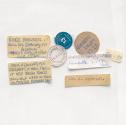
ProvenanceSticker on the back records used in a Colchester barber shop and passed down through the family; John Warrell; [Jonathan Horne, London]; [Longridge Collection, Christie’s, New York, January 24, 2011, lot 109]; Mary and Peter White; [Bonhams, London, December 5, 2025, lot 13]; purchased by MFAH, 2025.
Published References Grigsby, Leslie B. The Longridge Collection of English Slipware and Delftware. Vol. 2. London: Jonathan Horne Publications, 2000.461, D412. White, Mary. Living at the Whites' House. Vol. 4. Self-published, 2023. 2. Inscriptions, Signatures and Marks
Cataloguing data may change with further research.
If you have questions about this work of art or the MFAH Online Collection please contact us.