Slab Table
- Slab Table
Explore Further
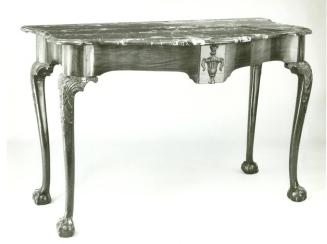
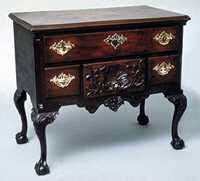
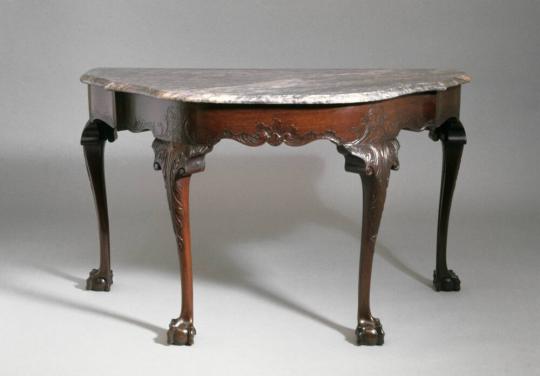
The 1772 Philadelphia cabinetmakers’ price book lists “frame for Marble Slab,” specifying that the basic model was four feet in length, to which could be added a range of options, primarily for the table supports. One could select Marlborough or cabriole legs, the latter, with “Claw feet,” “Leaves on the knees,” and “Carved Moldings,” a description reminiscent of the Bayou Bend table, being the most costly. While the price book records the basic form in either mahogany or walnut, all of the available options are specified only in mahogany, further asserting the slab table’s prominence as well as expense.
The marble tops for many of these tables were quarried outside Philadelphia at King of Prussia. In 1748 Peter Kalm visited the site and commented that it “is very good for working, though it is not one of the finest kinds of marble. People make tombstones and tables, enchase (encase) chimneys and doors and lay floors and flags in front of fireplaces, of this kind of marble. A quantity of this commodity is shipped to different parts of America.” An approximate value for the marble can be inferred from John Cadwalader’s accounts when he was remodeling his Philadelphia residence. David and William Chambers, marble masons, billed him twelve shillings per foot of new marble. Applying that formula, a top corresponding to the dimensions of the Bayou Bend table would cost approximately five pounds, exactly the same amount as the finest mahogany frame specified on the price list.
This extraordinary table, together with its mate in the Pendleton Collection, Rhode Island School of Design, Providence, must have made an impressive ensemble in eighteenth-century Philadelphia. They were probably commissioned for a principal parlor, or perhaps adjoining rooms, where their placement produced a mirrored symmetry. Although neither provenance is known prior to the twentieth century, there is no doubt they were conceived as a pair. This is confirmed by the subtle yet complementary variations observed on the two pieces: for example, on the Bayou Bend frame the carved leaves trailing down the legs curl outward, while on the Pendleton table they turn inward. The central ruffles carved on the skirts, while identical in execution, also display a paired orientation, maintaining an asymmetry consistent with Rococo dictates.
Related examples: Monkhouse and Michie 1986, p. 110, no. 48.
Book excerpt: Warren, David B., Michael K. Brown, Elizabeth Ann Coleman, and Emily Ballew Neff. American Decorative Arts and Paintings in the Bayou Bend Collection. Houston: Princeton Univ. Press, 1998.
ProvenanceHiram Rickert (1898–1972), Yardley, Pennsylvania; [Israel Sack, Inc., New York]; purchased by Miss Ima Hogg, 1959; given to MFAH, by 1966.
Published References The Magazine Antiques 60 (November 1951), p. 354; The Magazine Antiques 76 (July 1959), inside front cover; American Antiques from Israel Sack Collection, vols. 1−10. Washington, D.C.: Highland House Publishers, 1969−92, vol. 1, p. 83, no. 257; Comstock, Helen. American Furniture, Seventeenth, Eighteenth, and Nineteenth Century Styles. New York: Viking Press, 1962, no. 388; Warren, David B. ‘‘American Decorative Arts in Texas: The Bayou Bend Collection of the Museum of Fine Arts of Houston.” The Magazine Antiques 90 (December 1966), p. 799; Warren, David B. Bayou Bend: American Furniture, Paintings and Silver from the Bayou Bend Collection. Houston: Museum of Fine Arts, Houston; Boston: New York Graphic Society, 1975, p. 59, no. 114; Agee, William C., et al. The Museum of Fine Arts, Houston: A Guide to the Collection. Houston: Museum of Fine Arts, Houston, 1981, p. 77, no. 136; Fairbanks, Jonathan L., and Elizabeth Bidwell Bates. American Furniture, 1620 to the Present. New York: R. Marek, 1981, p. 166; Heckscher, Morrison H. American Furniture in the Metropolitan Museum of Art. New York: Metropolitan Museum of Art and Random House, 1985, p. 160; Monkhouse, Christopher P. and Thomas S. Michie. American Furniture in Pendleton House. Providence: Rhode Island School of Design, Museum of Art, 1986, p. 110; Sack, Harold, and Max Wilk. American Treasure Hunt, The Legacy of Israel Sack. Boston: Little, Brown, and Co., 1986, pp. 178–81; Warren, David B. Bayou Bend: The Interiors and the Gardens. Houston: Museum of Fine Arts, Houston, 1988, p. 23. Inscriptions, Signatures and Marks
Cataloguing data may change with further research.
If you have questions about this work of art or the MFAH Online Collection please contact us.