Spout Cup
- Spout Cup
Explore Further
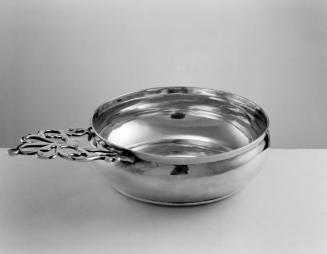
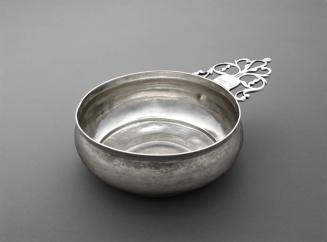
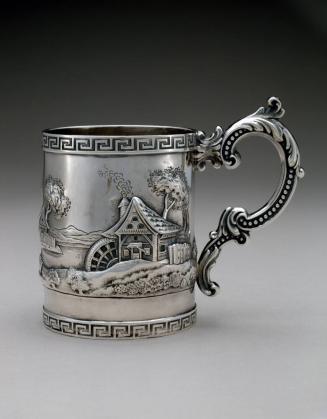
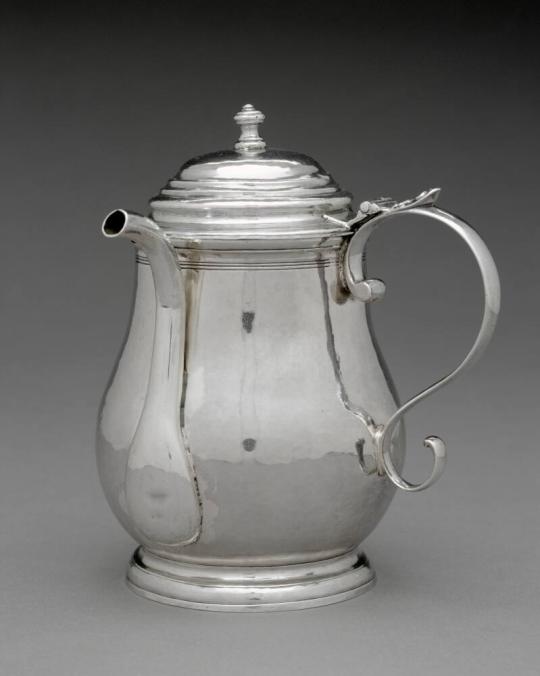
The spout cup is a colonial drinking vessel believed to have been used by the infirm, although it has also been suggested that it was designed for frothy beverages such as posset and syllabub. The cup is shaped like a can with a spout that functioned like a straw attached at the base. For convenience, the handle was positioned at a right angle to the spout, and the cover prevented spillage, kept the beverage warm, and protected against insects. Judging from the number of extant examples, it was most common in Boston.
Technical notes: The cup is raised. The foot, handle, and finial are cast. The interior is pierced for the spout. The lid is attached with a three-part hinge. The finial is soldered on. Decorative engraving around the center point suggests a fleur-de-lis.
Related examples: This spout cup is the only extant example of the form from John Burt's shop. One other hinged spout cup is recorded, perhaps inspired by covered cream pots, in Buhler 1972, vol. 1, p. 180, no. 144.
Book excerpt: David B. Warren, Michael K. Brown, Elizabeth Ann Coleman, and Emily Ballew Neff. American Decorative Arts and Paintings in the Bayou Bend Collection. Houston: Princeton Univ. Press, 1998.
ProvenancePossibly fashioned by John Burt for his own family; Edward Eastman Minor (1876–1953), Mount Carmel, Connecticut; given to his daughter Margaret Eastman Minor Prince (1913–1968), Chevy Chase, Maryland; purchased by Miss Ima Hogg, 1954; given to MFAH, 1969.
Published References Minor, Edward E. "Notes on Early American Silver." The Magazine Antiques 49 (April 1946), p. 238; Warren, David B. Bayou Bend: American Furniture, Paintings and Silver from the Bayou Bend Collection. Houston: Museum of Fine Arts, Houston; Boston: New York Graphic Society, 1975, p. 160, no. 303; Kane, Patricia E., ed. Colonial Massachusetts Silversmiths and Jewelers: A Biographical Dictionary Based on the Notes of Francis Hill Bigelow and John Marshall Phillips. New Haven: Yale University Art Gallery, 1998, p. 254. Inscriptions, Signatures and Marks
Cataloguing data may change with further research.
If you have questions about this work of art or the MFAH Online Collection please contact us.