Shop Figure
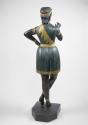
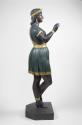
- Shop Figure
Explore Further
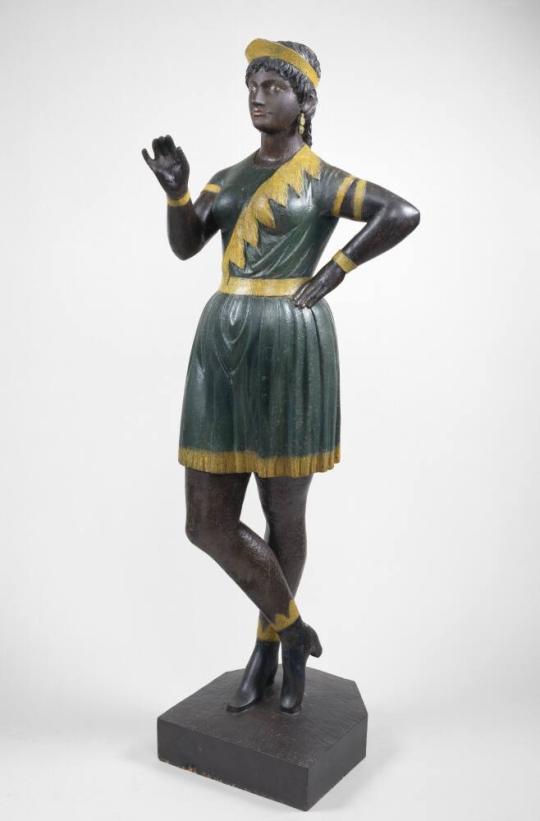
Although freestanding wooden shop figures made for tobacconists appeared in the United States as early as the eighteenth century, they did not reach their peak of popularity until after 1850. In seaport cities, as the demand for ship figureheads waned, carvers began to produce figures that combined the size of the figurehead with the full length of the smaller shop figure, thus creating a new tradition of life-size, full-length shop figures. The technique involved inserting an iron bar for support in either end of the raw log, allowing the log to hang free as the carver worked it. A plug in the head of this figure confirms that its maker was working in that tradition. Native Americans were the most popular representation, but Turks, Scotsmen, Jack Tars, and ladies and gentlemen of fashion were also prevalent.
Paint analysis of this figure reveals that she was originally a red-haired Caucasian wearing a gold-fringed, white tunic and bright green tights. While her headpiece relates to the crowns seen on Goddess of Liberty figures and her facial features have strong Neoclassical overtones, the identity of her original character is not clear. However, the costume suggests she was intended to portray some sort of performer or acrobat and thus was likely a type of “theatrical” figure that was displayed outside theaters. Over the years, the figure received many layers of new paint, something not unexpected for a wooden figure exposed to the elements. In her last incarnation, she was converted into a Native American, her skin darkened and her garments painted in dark green with yellow fringe, a scheme that appears on related figure dating from the last decade of the nineteenth century.
Adapted from Book excerpt: David B. Warren, Michael K. Brown, Elizabeth Ann Coleman, and Emily Ballew Neff. American Decorative Arts and Paintings in the Bayou Bend Collection. Houston: Princeton Univ. Press, 1998.
Provenance[T. V. Carey Antiques and Decorations, Boston]; purchased by Miss Ima Hogg, 1927; given to MFAH, 1968.
Published References Warren, David B. “A Great Texas Collection of Americana: The Bayou Bend Collection at the Museum of Fine Arts, Houston.” The Connoisseur 178 (September 1971), p. 55, fig. 31; Bishop, Robert. American Folk Sculpture. New York: E. P. Dutton and Co., 1974, no. 489; Warren, David B. Bayou Bend: American Furniture, Paintings and Silver from the Bayou Bend Collection. Houston: Museum of Fine Arts, Houston; Boston: New York Graphic Society, 1975, p. 123, no. 233; Warren, David B. Bayou Bend: The Interiors and the Gardens. Houston: Museum of Fine Arts, Houston, 1988, p. 55. Inscriptions, Signatures and Marks
Cataloguing data may change with further research.
If you have questions about this work of art or the MFAH Online Collection please contact us.