
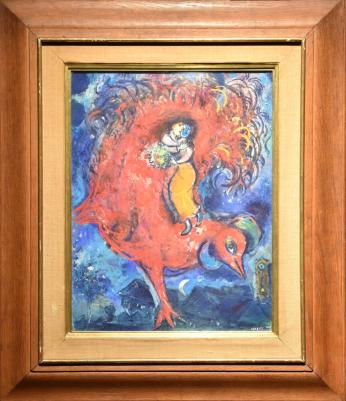
Le Palmier [The Palm Tree]
![Le Palmier [The Palm Tree]](/internal/media/dispatcher/467143/preview)

Artist
Marc Chagall (Belarusian, active France, 1887–1985)Belarusian, active France, 1887–1985
CultureFrench; Russian
Titles
- Le Palmier [The Palm Tree]
Date1949
PlaceParis, France
MediumWatercolor and gouache on paper
DimensionsSheet: 30 3/4 × 22 1/4 in. (78.1 × 56.5 cm)
Frame: 41 5/16 × 32 15/16 × 2 1/8 in. (104.9 × 83.7 × 5.4 cm)
Frame: 41 5/16 × 32 15/16 × 2 1/8 in. (104.9 × 83.7 × 5.4 cm)
Credit LineBequest of Hugo V. Neuhaus, Jr.
Object number2025.800
Not on view
Explore Further
Department
Prints and DrawingsObject Type
[1] Hugo V. Neuhaus, Jr. (1915–1987) [Fig. 9] was among Houston’s leading modernist architects, and a staunch supporter of Houston’s cultural philanthropies. A native Houstonian, Neuhaus was a graduate of St. Paul's School, Concord, New Hampshire (1934), Yale College (A.B., 1938), and the Graduate School of Design, Harvard University (B.Arch., 1941). He served in the United States Army Air Force from 1941 to 1946, attaining the rank of major. Upon returning to Houston in 1946, Neuhaus worked briefly for the architect Kenneth Franzheim, then entered the offices of C. Herbert Cowell (1947) and Magruder Wingfield, Jr. (1962), establishing his own firm, Neuhaus Associates, in 1967. When Philip Johnson was commissioned to design a house for Dominique and John de Menil in 1949, he asked Neuhaus to serve as his local associate architect. As a result of this collaboration, Neuhaus became a devoted admirer of both Johnson, and his mentor Ludwig Mies van der Rohe, whose influence profoundly shaped his practice.
Among the founders of the Contemporary Arts Association (now the Contemporary Arts Museum Houston) in 1948, Neuhaus joined the board of trustees of the Museum of Fine Arts, Houston in 1952, and over the subsequent three decades he took an active role in the supporting the museum’s accessions, the construction of Cullinan Hall, the construction of the Brown Pavilion, and many other activities, becoming a life trustee in 1986. Among his bequests to the MFAH was a cash donation which underwrote the establishment of our first conservation center, and his notable collection of Modern art, which ranged from the Post-Impressionists to such mid-century mavericks as Helen Frankenthaler, Hans Hofmann, and Morris Louis was also bequeathed to the Museum. His widow, Olive Neuhaus Jenney held the collection in trust over the subsequent years, and with her passing in 2024, the collection was turned over to the Museum.
Exhibition Historynone known
Published References none Inscriptions, Signatures and Marks
Recto: Dated in black pigment, right bottom edge: 1949
Recto: Signed and inscribed in black pigment, bottom right corner: Marc // Chagall // St. JEAN C. FERRA
Verso: [inaccessible]
Recto: Signed and inscribed in black pigment, bottom right corner: Marc // Chagall // St. JEAN C. FERRA
Verso: [inaccessible]
Lower right "Marc Chagall"
[inaccessible]
Catalogue raisonnénone
Cataloguing data may change with further research.
If you have questions about this work of art or the MFAH Online Collection please contact us.
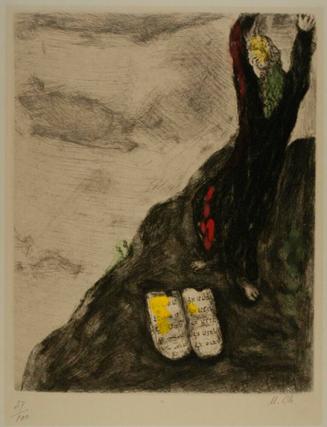
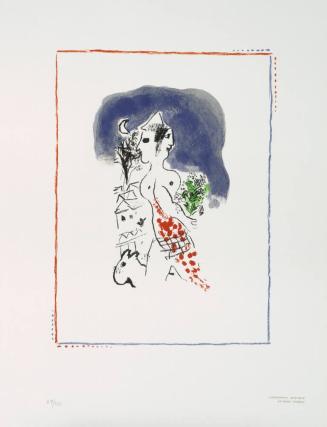
Marc Chagall
after 1931
Lithograph
86.402
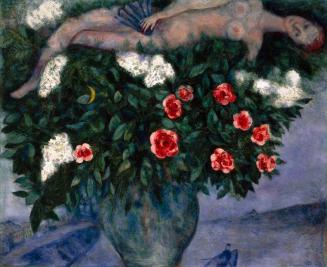
Pierre Bonnard
1925
Watercolor and gouache on wove paper
2025.825
![Woodman’s Cottage, Bagley Wood [recto]; Study of Young Oak Trees (Bagley Wood) [verso]](/internal/media/dispatcher/425171/thumbnail)
William Turner of Oxford
c. 1830
Watercolor, gouache, and graphite on blue wove paper (recto); graphite with white gouache on blue wove paper (verso) in a washline mount
2024.16.A,.B