Teapot


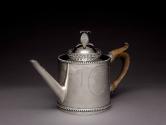
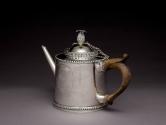
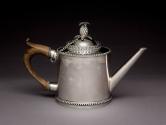
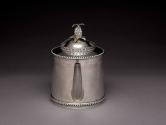
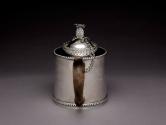
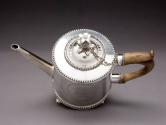
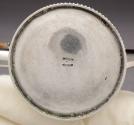
- Teapot
Explore Further
John David’s father, silversmith Peter David, was born in New York of Huguenot ancestry. He was active by 1735 as a silversmith in Philadelphia. John David almost certainly learned the trade from his father. John David first advertised on his own in January 1763. Purchases he made beginning in February 1763 from the estate of silversmith Philip Hulbeart suggest that he was establishing his own shop. In 1769, among the taxes he paid was a £4 assessment on an enslaved person; by 1783, he enslaved three persons. He gained notable clients in the 1770s, such as John Dickinson and Benjamin Chew, and made goods for silversmiths Joseph and Nathaniel Richardson. David died of yellow fever in Philadelphia in January 1794.
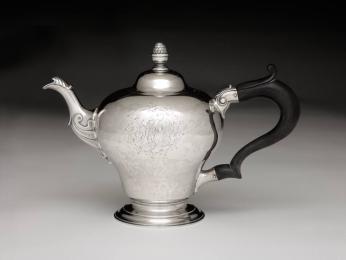
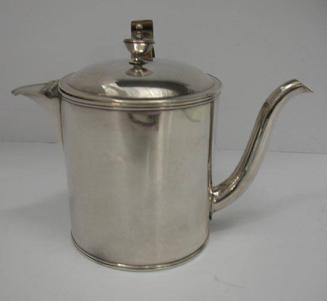
Though the cylindrical form of this teapot would suggest its fabrication from manufactured sheet silver, it was instead crafted by the more traditional process of raising, or systematically hammering the silver over steel stakes to create the desired form. In keeping with the neoclassical aesthetic, the teapot is of a straightforward geometrical form, its visual clarity strengthened by the bold, beaded edges that outline it.
Provenance[Ron Klinger, Philadelphia, 1991]; Charles C. Williams (1925–1996), Washington, D.C.; [South Bay Auctions, East Moriches, New York, June 12, 2021, lot 107]; [Lamb Silver]; [Shrubsole, New York]; purchased by MFAH, 2025.
Inscriptions, Signatures and Marks
Cataloguing data may change with further research.
If you have questions about this work of art or the MFAH Online Collection please contact us.