Porringer
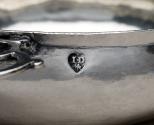
- Porringer
Explore Further
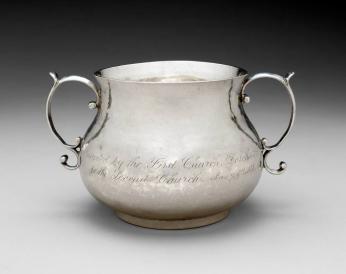
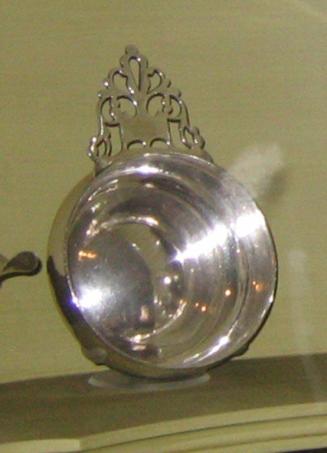
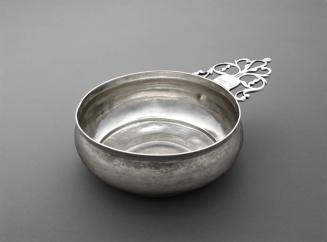
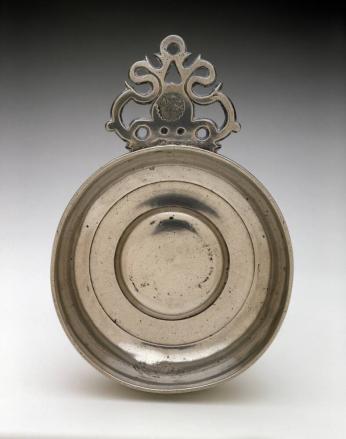
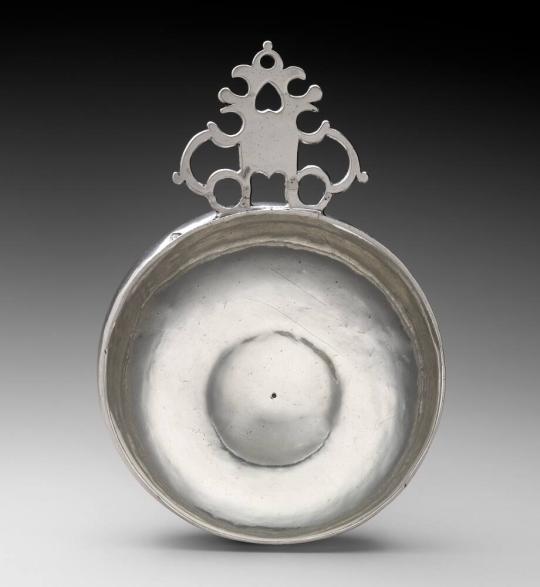
The porringer’s name, shape, and function are derived from the French potager, or soup bowl, and the form is also related to the écuelle. Produced in England by the 1620s, the earliest examples, both English and American, are characterized by a simplicity of form, the bowl having little contour and the handle a shield-shaped or geometric pattern.
Contemporary accounts identify the porringer as a multipurpose vessel. Its conventional use was as a bowl from which one ate or drank. Other sources identify a diversity of uses. William Penn's wife, Gulielma, adapted a pewter porringer as a measure and a silver one for steeping shredded lemon peel. Perhaps its most unconventional application was noted by Dr. Alexander Hamilton, who observed a woman mixing her rouge in a porringer.
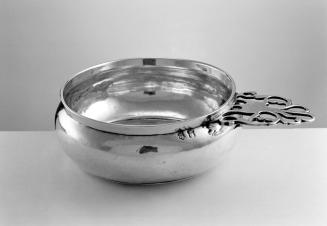
Jeremiah Dummer is the earliest native-born silversmith whose work is known. His porringer, with its slightly domed bottom, rounded sides, and everted lip, realizes the shape that remains characteristic today.
Technical notes: Typically, silver holloware was raised, or hammered up, while the handle was cast and soldered on; its tip is a replacement.
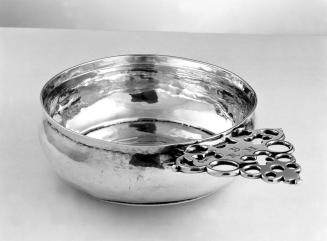
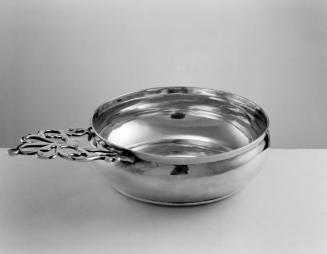
Related examples: Dummer is known to have employed no fewer than five different patterns for porringer handles. The Bayou Bend example is related to Flynt and Fales 1968, pp. 73–75, no. 49; Buhler 1972, vol. 1, p. 20, no. 17; and an unpublished example belonging to the Addison Gallery of American Art, Andover, Massachusetts. The prototype can be found in English silver and pewter, such as a porringer by London pewterer John Waite (Payson 1978, p. 12). A variant was later adopted by American pewterers (see B.58.97).
Book excerpt: David B. Warren, Michael K. Brown, Elizabeth Ann Coleman, and Emily Ballew Neff. American Decorative Arts and Paintings in the Bayou Bend Collection. Houston: Princeton Univ. Press, 1998.
Provenance[Yale University Art Gallery, New Haven, by 1935]; [James Graham and Sons, New York] purchased by Miss Ima Hogg, 1956; given to MFAH, 1969.
Published References Clarke, Hermann Frederick, and Henry Wilder Foote. Jeremiah Dummer, Colonial Craftsman and Merchant, 1645−1718. Boston: Houghton Mifflin, 1935, p. 151, no. 61; Minor, Edward E. "Notes on Early American Silver." The Magazine Antiques 49 (April 1946), p. 239; Art Treasures Exhibition. New York: Antique and Art Dealers Association, 1955, no. 121; Warren, David B. Bayou Bend: American Furniture, Paintings and Silver from the Bayou Bend Collection. Houston: Museum of Fine Arts, Houston; Boston: New York Graphic Society, 1975, p. 155, no. 290; Kane, Patricia E., ed. Colonial Massachusetts Silversmiths and Jewelers: A Biographical Dictionary Based on the Notes of Francis Hill Bigelow and John Marshall Phillips. New Haven: Yale University Art Gallery, 1998, p. 392. Inscriptions, Signatures and Marks
Cataloguing data may change with further research.
If you have questions about this work of art or the MFAH Online Collection please contact us.