Pitcher and Tray
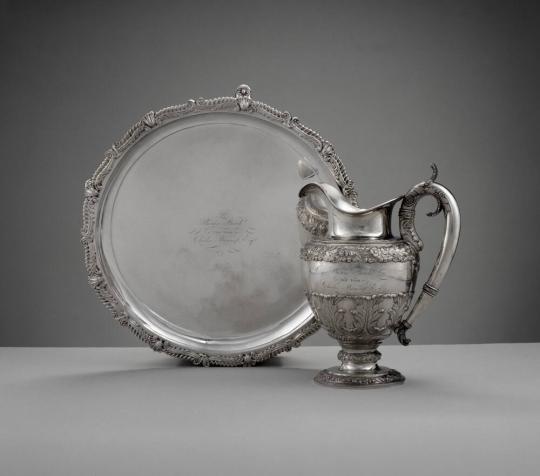
- Pitcher and Tray
Tray: 2 × 17 3/4 in. diameter (5.1 × 45.1 cm)
Explore Further
The pitcher, introduced to the United States at the end of the eighteenth century, became a predominant table form in the nineteenth century. English creamware and pearlware pitchers provided silversmiths with the earliest prototypes. While that shape is now popularly identified with Paul Revere, other Boston and New York silversmiths fashioned similar vessels. The Bayou Bend pitcher presents the subsequent interpretation, which, along with its companion tray, magnificently adheres to the Grecian aesthetic.
Technical notes: A band has been incorporated below the tray’s decorative rim, undoubtedly to strengthen it. The handle terminal is vented.
Related examples: An identical pitcher and tray purportedly were presented to Horatio Gates, whose niece married Charles Bancroft. It is said to remain with Gates’s descendants. Other silver engraved with Richard’s name includes Antiques 82 (December 1962), p. 581; Christie’s, New York, sale 5370, June 2, 1983, lot 69; Feld et al. 1991, p. 20, no. 2; Quimby 1995, pp. 277–78, no. 242.
Book excerpt: David B. Warren, Michael K. Brown, Elizabeth Ann Coleman, and Emily Ballew Neff. American Decorative Arts and Paintings in the Bayou Bend Collection. Houston: Princeton Univ. Press, 1998.
ProvenanceCharles Bancroft; by descent to Stephen Bancroft; consigned to [Sotheby Parke Bernet, New York, sale 4905Y, June 30–July 1, 1982, lot 192]; private collection; [Hirschl & Adler Galleries, New York]; purchased by MFAH, 1991.
Published References Denison 1966, p. 78; Sotheby Parke-Bernet, New York, sale 4905Y, June 30–July 1, 1982, lot 192; Warren, David B., Katherine S. Howe, and Michael K. Brown. Marks of Achievement: Four Centuries of American Presentation Silver. Houston: Museum of Fine Arts, Houston, in association with Harry N. Abrams, New York , 1987, pp. 92–93, no. 103; Feld, Stuart P., et al. Neo-Classicism in America: Inspiration and Innovation 1810−1840. Exh. cat. New York: Hirschl and Adler Galleries, 1991, p. 35, no. 18; Quimby, Ian M. G., with Dianne Johnson. American Silver at Winterthur. Winterthur: Henry Francis du Pont Winterthur Museum, 1995, p. 277. Inscriptions, Signatures and Marks
Cataloguing data may change with further research.
If you have questions about this work of art or the MFAH Online Collection please contact us.