Pair of Furniture Knobs
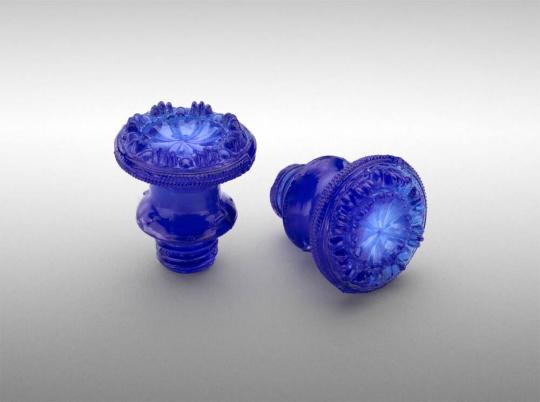
- Pair of Furniture Knobs
Explore Further
As early as 1817, Henry Bradshaw Fearon, a British traveler, commented on the dazzling effects of the cut glass hardware that he observed on New York cabinetwork. While furniture knobs were initially fashioned of cut glass, with the introduction of machine pressing in the late 1820s, this form was among the first to be mass-produced.
The earliest known patent to mention pressing glass was issued on November 4, 1826, to Henry Whitney and Enoch Robinson of the New England Glass Company. The instant and widespread popularity of this invention is inferred from Whitney and Robinson’s claim that in 1827 and 1828 they had produced no less than 30,000 knobs. Within the decade at least twenty-four patents were granted for pressing glass, and thirteen of those specifically described the design or production of furniture and doorknobs. The fashion for the glass knobs in pressed designs for stylish mahogany and figured maple furniture spanned a generation before it began to decline about 1850.
Provenance[Ian Simmonds, Dobbs Ferry, New York]; purchased by Susan Neptune, Houston; given to MFAH, 2012.
Published References Identical examples are published in: Helen McKearin, "The Case of the Pressed Glass Knobs." The Magazine Antiques 60, no. 2 (August 1951), pp.118-19. Kenneth M. Wilson. New England Glass and Glassmaking (New York, 1972), pp.258-59 Jane Shadel Spillman, American and European Pressed Glass in The Corning Museum of Glass (Corning, New York, 1981), p.36. Kenneth M. Wilson. American Glass: 1760-1930 (New York, 1994), pp.274, 293 Kenneth M. Wilson and Kirk J. Nelson. "The role of glass knobs in glassmaking and furniture." The Magazine Antiques 149, no. 5 (May 1996), pp.755, 753, 758
Cataloguing data may change with further research.
If you have questions about this work of art or the MFAH Online Collection please contact us.