
[Man Wearing Glasses, Semi-Profile]
![[Man Wearing Glasses, Semi-Profile]](/internal/media/dispatcher/302072/preview)
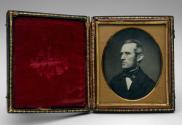
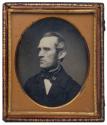

- [Man Wearing Glasses, Semi-Profile]
Explore Further
In the 1840s and 1850s, men and women who just a short
time earlier could not have dreamed of holding a lifelike image of a loved one
or of leaving a true record of their own features for posterity were offered
just such a possibility. Daguerreotypes—invented by the French painter,
showman, and entrepreneur Louis Daguerre—were magically precise images made
directly in the camera on silver-plated sheets of copper sensitized with iodine
and developed in mercury fumes. First shown publicly in Paris in 1839, the
process spread around the world like wildfire. In America, major cities quickly
boasted lavishly appointed portrait studios, and itinerant daguerreotypists
moved from one small town to another, setting up a temporary studio for a day
or two before moving on to the next locale. Those who could not afford a “whole-plate”
daguerreotype (6 ½ x 8 ½ inches, the largest standard size) opted for a
“half-plate” likeness, and those who could not afford that chose a
quarter-plate, a sixth-plate, a ninth-plate, or even a sixteenth-plate.
Millions of such portraits were produced in America, quickly replacing the
traditions of painted miniatures and cut silhouettes.
This sixth-plate daguerreotype was a modest work of art
most likely made by a journeymen photographer. The identity of the sitter, too,
is now lost to history. Nonetheless, such daguerreotypes must have seemed
miraculous in an age unaccustomed to photography and been treasured as precious
keepsakes of beloved sons and daughters, husbands and wives, mothers and
fathers. Even today, close examination seems to offer a window into a long-ago
life.
ProvenanceSonia Marvins, Houston; given to MFAH, 2003.
Exhibition HistoryExhibited: "Recent Acquisitions," the Museum of Fine Arts, Houston, 12/22/03-2/29/04
"Turning Light Into Silver", 19 February - 30 May 2005, Audrey Jones Beck Building, The Museum of Fine Arts, Houston, lower level.
Cataloguing data may change with further research.
If you have questions about this work of art or the MFAH Online Collection please contact us.
![[Man with Facial Hair in Semi-Profile]](/internal/media/dispatcher/300004/thumbnail)
![[Woman Wearing Glasses]](/internal/media/dispatcher/318622/thumbnail)
![[Woman in Semi-Profile with Shawl]](/internal/media/dispatcher/318597/thumbnail)
![[Woman Wearing Glasses]](/internal/media/dispatcher/420534/thumbnail)
![[Woman Wearing Glasses]](/internal/media/dispatcher/390114/thumbnail)
![[Woman and Young Boy]](/internal/media/dispatcher/420542/thumbnail)
![[Man with White Hair]](/internal/media/dispatcher/318605/thumbnail)
![[Man with Bow Tie]](/internal/media/dispatcher/318606/thumbnail)
![[Woman Wearing Bonnet]](/internal/media/dispatcher/318614/thumbnail)
![[Man and Young Girl Holding Purse]](/internal/media/dispatcher/381632/thumbnail)
![[Woman Wearing Bonnet]](/internal/media/dispatcher/46874/thumbnail)
![[Seated Man Wearing Striped Vest]](/internal/media/dispatcher/380766/thumbnail)