A Bejeweled Lady
- A Bejeweled Lady
Mount: 7 1/4 × 5 in. (18.4 × 12.7 cm)
Explore Further
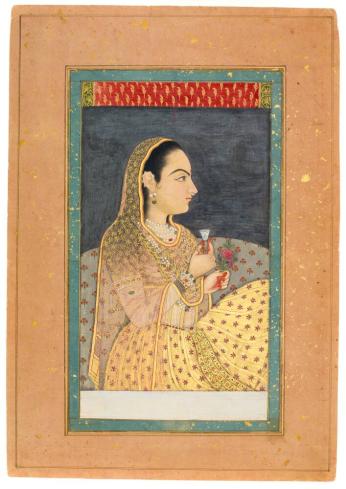
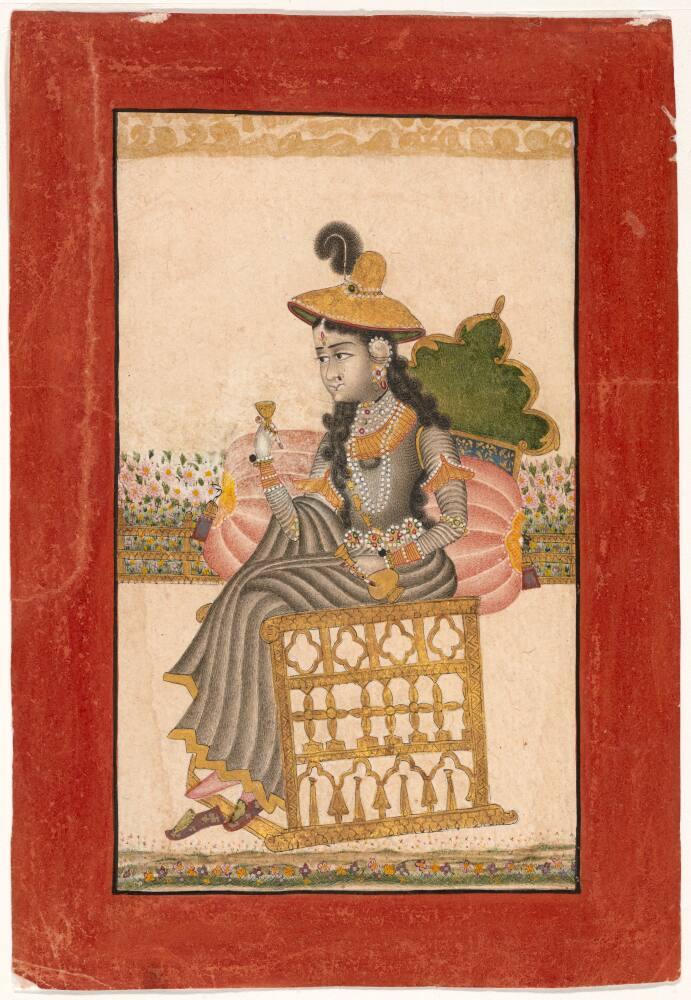
This painting of an elegantly dressed woman in a European-style velvet costume dates to the end of the Mughal dynasty (1526–1707). The Mughal reign fostered a great flowering in the visual and poetic arts that extended throughout the Indian subcontinent.
In addition to her luxurious gown, the subject of this painting wears ornate slippers, one of which has slipped off to reveal the toe of a pink silk stocking. She is draped in jewels and pearls and holds a small gold cup and ewer. A broad-brimmed hat keeps the sun off her light face; her pale skin was associated with not having to work outside and was thus a highly valued trait. She sits in a gilt wood chair with pink tasseled bolster.
A Bejeweled Lady was painted in Kotah, one of the Mughal empire's major artistic centers that continued to flourish after the fall of the dynasty. Though influenced by Mughal court painting, artists from Kotah established their own school, incorporating vivid use of color and tending to favor landscapes over portraiture. This love of nature can be seen in the careful rendering of the garden around the woman.
ProvenanceSotheby's sale of Oriental MSS and Miniatures, 7 December 1971 (Kofler - Truniger collection), lot 98, purchased by the dealer Sven Gahlin for GBP 110; Spink & Son, Ltd., London; Stephen E. Hamilton, Houston, Tex., December 23, 1983;
Exhibition HistoryThe Museum of Fine Arts, Houston, October 2003.
Published References The Deccani artist whose known work most closely resembles this miniature is Rahim Deccani, active in Golconda in the last quarter of the seventeenth century. See Mark Zebrowski, Deccani Painting pp. 201-04 and plates 169-76. His work mingles isolated figures in European costume with others in traditional Indian dress. The figure of a young girl standing to the right of the seated prince in plate 176 bears a striking resemblance to the lady depicted in this work. This painting also exhibits features which differ from the Golconda miniature; the chair which differs from the Deccani prototype in its "rickety structure," and the "plumelike clouds" suggest Kotah as a particular site of origin. See Binney, Rajput Miniatures, p. 33. As to the seductive pose of the figure, compare India Office Library, Johnson Album 10, no. 1 ("A European lady in Indian Dress"). Another published version of this composition (there attributed to a Hyderabad artist) is in the John Gilmore Ford collection, Baltimore. Inscriptions, Signatures and Marks
Cataloguing data may change with further research.
If you have questions about this work of art or the MFAH Online Collection please contact us.