Cann
- Cann
Explore Further
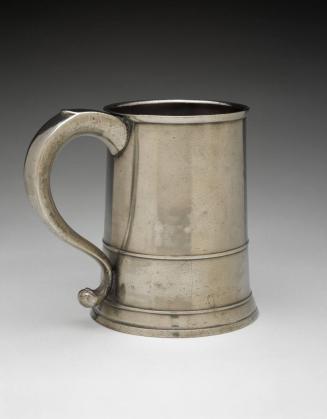
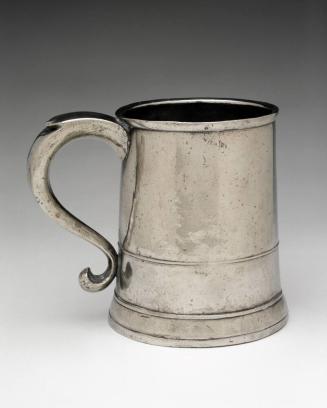
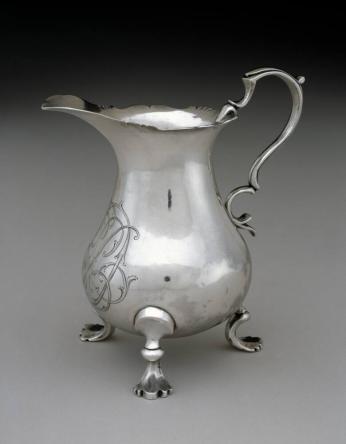
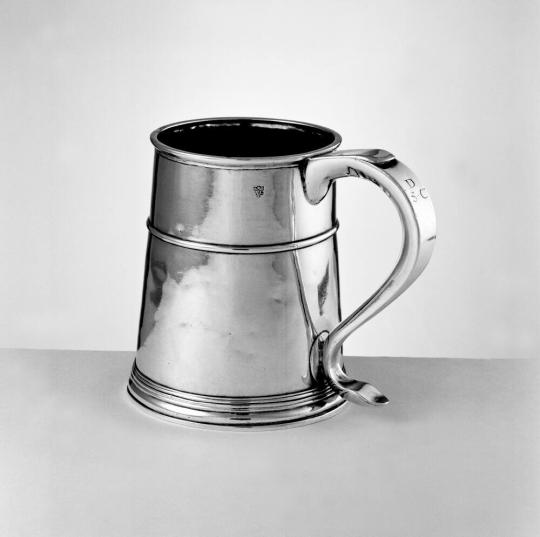
During the course of his career a silversmith used one or more stamps to sign his shop's production. In time these marks either wore out or were updated, responding to changes within the shop or the latest style. Initial marks can be difficult to attribute; for instance, William Cowell, Sr. and Jr., used the same surname stamp. The Bayou Bend can is enlightening as it is struck with the Cowell surname mark as well as an initial mark, which predates the son’s tenure. This vessel, with a thinner mid-band and more complex base molding than the Peter Oliver can (B.69.92), demonstrates the form's evolution.
Technical notes: The can is raised with a two-part handle, which is attached to a disk at the base.
Related examples: Jones 1913, pp. 207–8, pl. LXXIII,I; Antiques 107 (March, 1975) p. 418.
Book excerpt: David B. Warren, Michael K. Brown, Elizabeth Ann Coleman, and Emily Ballew Neff. American Decorative Arts and Paintings in the Bayou Bend Collection. Houston: Princeton Univ. Press, 1998.
Provenance[Whimsy Antiques, Arlington, Vermont]; purchased by Miss Ima Hogg, 1961; given to MFAH, by 1966.
Published References The Magazine Antiques 80 (August 1961), p. 107; Warren, David B. Bayou Bend: American Furniture, Paintings and Silver from the Bayou Bend Collection. Houston: Museum of Fine Arts, Houston; Boston: New York Graphic Society, 1975, p. 152, no. 281: Kane, Patricia E., ed. Colonial Massachusetts Silversmiths and Jewelers: A Biographical Dictionary Based on the Notes of Francis Hill Bigelow and John Marshall Phillips. New Haven: Yale University Art Gallery, 1998, p. 352. Inscriptions, Signatures and Marks
Engraved on bottom: H-M [added later]
Left of handle: initial mark of William Cowell [Buhler and Hood 1970, vol. I, p. 324, nos. 89–90, 93–94]
Cataloguing data may change with further research.
If you have questions about this work of art or the MFAH Online Collection please contact us.