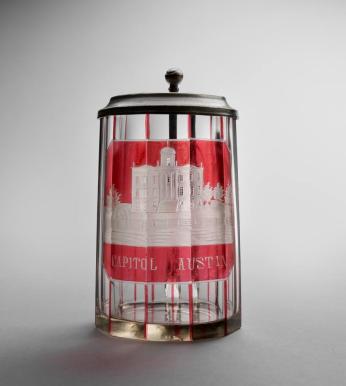
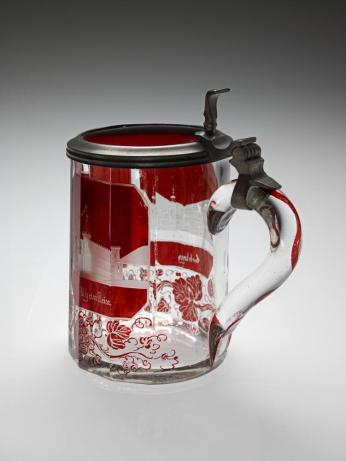
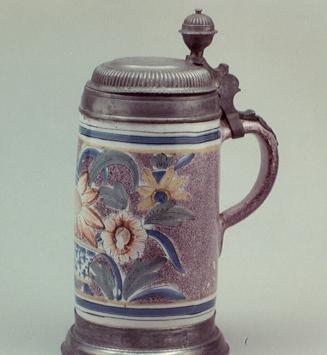
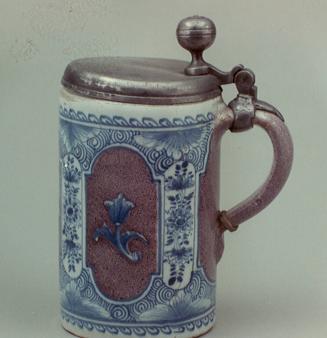
Tankard
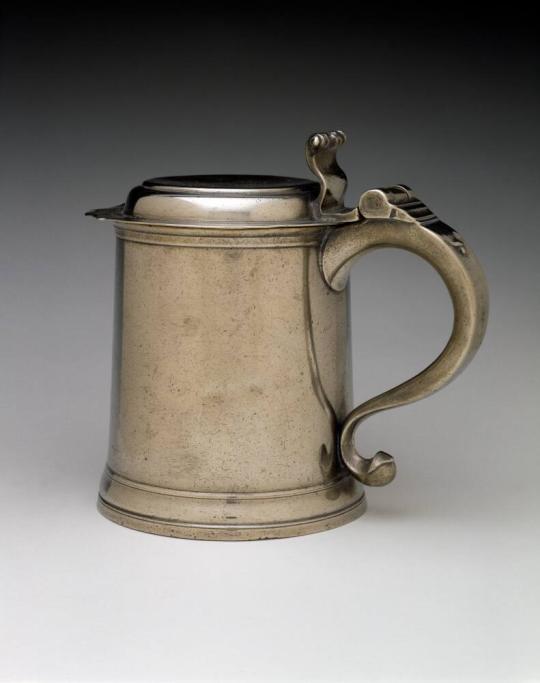
- Tankard
Explore Further
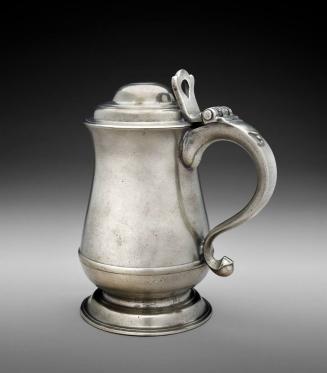
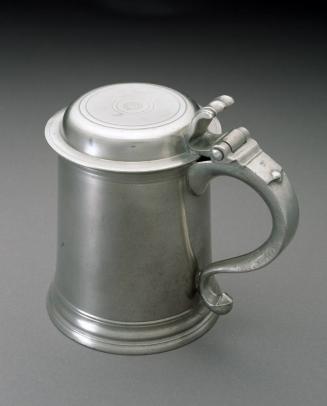
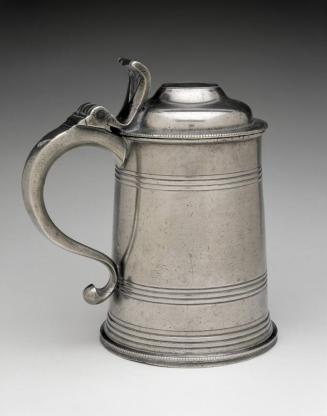
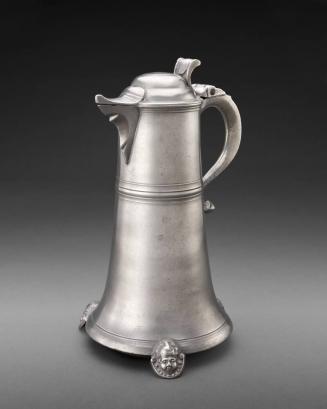
The tankard was a popular drinking vessel in seventeenth- and eighteenth-century America, and some pewter examples are known as late as the first quarter of the nineteenth century. Their capacity ranged from a pint to as much as two quarts, although most held one quart. New York tankards, in either silver or pewter, exhibit little concession to the stylistic dictates of this period. By the second quarter of the eighteenth century, the tankard’s lid had evolved into a dome shape in Boston and Philadelphia, while New York’s preference for the crenellated flat lid persisted throughout the century.
On the death of John Bassett in 1761, his son Frederick, who had recently completed his apprenticeship, assumed responsibility for the operation of his father’s shop and became the third generation of his family to ply the craft. As his surviving work demonstrates a consistently high level of quality, he is acknowledged as the last of New York City's great pewterers.
Technical notes: The tankard is among the most complex domestic forms the pewterer produced. Five different molds were used to cast the base, body handle, thumbpiece, and lid, the latter attached with a three-part hinge here.
Related examples: Most closely related is Kerfoot 1942, fig. 20. Tankards in museum collections include Winchester et a1.1959, p. 189, no. 7; Fairbanks 1974, p. 63, no. 239; Montgomery 197S, pp. 118-19, 122, nos. 6–18, 6–22.
Book excerpt: David B. Warren, Michael K. Brown, Elizabeth Ann Coleman, and Emily Ballew Neff. American Decorative Arts and Paintings in the Bayou Bend Collection. Houston: Princeton Univ. Press, 1998.
Provenance[Whimsy Antiques, Arlington, Vermont]; purchased by Miss Ima Hogg, 1960; given to MFAH, by 1966.
Published References Warren, David B. ‘‘American Decorative Arts in Texas: The Bayou Bend Collection of The Museum of Fine Arts of Houston.” The Magazine Antiques 90 (December 1966), p. 808; Agee, William C., et al. The Museum of Fine Arts, Houston: A Guide to the Collection. Houston: Museum of Fine Arts, Houston, 1981, p. 77, no. 137; Butler, Barbara. “Pewter at Bayou Bend.” The Pewter Collectors’ Club of America 90−91 (March–September 1985), pp. 11–12; Warren, David B. Bayou Bend: The Interiors and the Gardens. Houston: Museum of Fine Arts, Houston, 1988, p. 15; American Heritage 1994, p. 826. Seven years after Miss Hogg’ s acquisition of Bassett’s tankard in 1960, the dealer advertised what appears to be the same vessel in The Magazine Antiques 92 (October 1967), p. 423. Inscriptions, Signatures and Marks
Cataloguing data may change with further research.
If you have questions about this work of art or the MFAH Online Collection please contact us.