Self-Portrait with Angelica and Portrait of Rachel
- Self-Portrait with Angelica and Portrait of Rachel
Explore Further
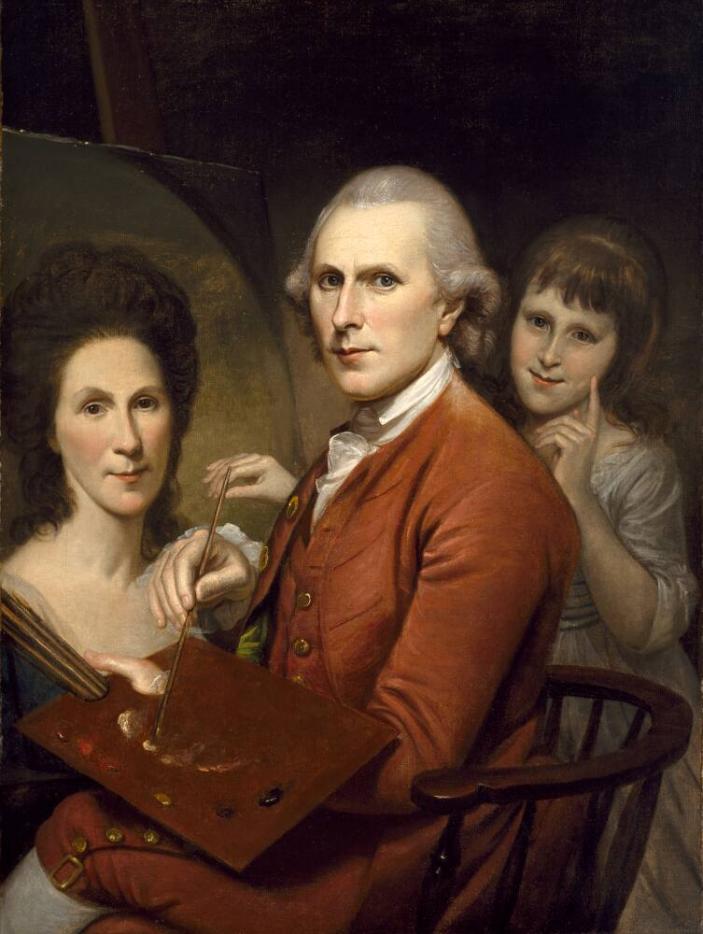
Charles Willson Peale painted a number of self-portraits throughout his career, but the Bayou Bend portrait is one of his most complex and revealing statements about his art and its close relationship to domesticity, family enterprise, and the educational role of art. Seated in a Windsor armchair while painting a portrait, the artist turns slightly and directs his gaze toward the viewer. Without actually gripping the brush, his daughter Angelica Kauffmann Peale (1775–1853) at right playfully appears to guide it with one hand, as her other hand points toward heaven, assuming the role of the allegorical muse of painting. To the left, Rachel Brewer Peale (1744–1790), the artist’s wife, peers out of the painted canvas toward the viewer with an expression as lifelike as those of the artist and daughter. Peale, then, challenges the viewer to consider issues of illusion and reality and the artist’s magical ability to transform pigment (as suggested by the blobs of paint revealed to the viewer on the palette, carefully juxtaposed with the vibrantly alive portrait of his wife on the easel). Such investigations into the art of portraiture as more than a mimetic enterprise are characteristic of the artist’s most sophisticated works (see also the conceit of a painting within a painting in B.55.15).
The painting has been variously dated. Charles Coleman Sellers first proposed c. 1782–85, which is supported by other Peale scholars. The date of 1790 was also proposed (and later rescinded) by Sellers; Rachel Brewer Peale died in 1790, which would make the portrait one of remembrance. Warren, however, argues for a date of c. 1788 based on the relative ages of the sitters and their appearance in the painting. Stylistically, the portrait compares most closely with Peale’s works of the earlier 1780s.
Related examples: Possible sources and prototypes cited by David Steinberg in Miller and Ward 1991 include Edward Fisher after Jean-Baptiste Van Loo, Colley Cibber and His Daughter, 1758, The Huntington Library, Art Collections and Botanical Gardens, San Marino, California; and Dirck Jacobsz, Jakob Cornelisz van Oostsanen Painting a Portrait of His Wife, c. 1550, Toledo; another interesting comparison is Gerrit van Honthorst, Pictura Is Painting a Likeness of the Artist or The Love of the Painter Is Returned by His Muse, 1648, Galerie Neuse, Bremen.
Book excerpt: David B. Warren, Michael K. Brown, Elizabeth Ann Coleman, and Emily Ballew Neff. American Decorative Arts and Paintings in the Bayou Bend Collection. Houston: Princeton Univ. Press, 1998.
ProvenanceBy tradition in the Peale Museum, Philadelphia, until 1854; to George Rowan Robinson, grandson of Angelica Kauffmann Peale Robinson (b. 1826), St. Louis: Mrs. Richard P. Esty, by 1952; [Kennedy Galleries. New York]; purchased by Miss Ima Hogg, 1960; given to MFAH, by 1966.
Exhibition HistoryPossibly Peale's portrait gallery, Philadelphia, c.1782, then the Peale Museum, Philadelphia, from c.1786–1854.
"The Fabulous Peale Family," Kennedy Galleries, New York, June 13–July 8, 1960
"The Voyage of Life," Bayou Bend Museum of Americana at Tenneco, Houston, TX, September 22, 1991–October 13, 1993.
Published References Art in America 2, no. 6 (1914), p. 424; Sellers, Charles Coleman. Portraits and Miniatures by Charles Willson Peale. Philadelphia: American Philosophical Society, 1952, p. 159, no. 626 (dates the painting to c. 1782–85, and painting is described as unlocated); Kennedy Quarterly 1, no, 3 (June 1960), p. 68, no. 69; The Magazine Antiques 77 (June 1960 ), p. 524; Warren, David B. ''American Decorative Arts in Texas: The Bayou Bend Collection of The Museum of Fine Arts of Houston." The Magazine Antiques 90 (December 1966), p. 798; Sellers, Charles Coleman. Charles Willson Peale. New York: Charles Scribner's Sons, 1969, pl. 6 (dates the painting to ca. 1790); Sellers, Charles Coleman. Charles Willson Peale with Patron and Populace: A Supplement to Portraits and Miniatures by Charles Willson Peale, with a Survey of his Work in other Genres. Transactions of the American Philosophical Society, n.s. 59, pt. 3. Philadelphia, 1969, pp. 75, 122, no. 107; Warren, David B. "A Great Texas Collection of Americana: The Bayou Bend Collection at the Museum of Fine Arts, Houston." The Connoisseur 178 (September 1971), p. 39; Warren, David B. Bayou Bend: American Furniture, Paintings and Silver from the Bayou Bend Collection. Houston: Museum of Fine Arts, Houston; Boston: New York Graphic Society, 1975, pp. 138–39, no. 260; Miller, Lillian B. "Charles Willson Peale as History Painter: The Exhumation of the Mastodon. “The American Art Journal 13, no. 1 (Winter 1981), pp. 47–68, especially pp. 67–68; Agee, William C., et al. The Museum of Fine Arts, Houston: A Guide to the Collection. Houston: Museum of Fine Arts, Houston, 1981, p. 87, no. 152; Richardson, Edgar P., Brooke Hindle, and Lillian B. Miller. Charles Willson Peale and His World. Exh. cat. New York: Harry N. Abrams, 1982, pp. 202, 208, 260; The Selected Papers of Charles Willson Peale and His Family. Vol. 1: Charles Willson Peale: Artist in Revolutionary America, 1735−1791. Vol. 2, parts 1 and 2: Charles Willson Peale: The Artist as Museum Keeper, 1791−1810. Vol. 3: The Belfield Farm Years, 1810−1820. Vol. 4: Charles Willson Peale: His Last Years, 1821−27. Edited by Lillian B. Miller, Sidney Hart, Toby A. Appel, and David C. Ward. New Haven: Yale University Press for The National Portrait Gallery; Smithsonian Institution, 1983−96, vol. 1, pl. 6; Marzio, Peter C., et al. A Permanent Legacy: 150 Works from the Collection of the Museum of Fine Arts, Houston. Houston: Museum of Fine Arts, Houston, 1989, pp. 262–63; David Steinberg, "Charles Willson Peale: The Portraitist as Divine," in Miller, Lillian B., and David C. Ward, eds. New Perspectives on Charles Willson Peale: A 250th Anniversary Celebration. Pittsburgh: University of Pittsburgh Press, 1991, pp. 131–43; Brigham, David R. Public Culture in the Early Republic, Peale's Museum and Its Audience. Washington and London: Smithsonian Institution Press, 1995, pp. 42–43; Wilson, Janet. The Ingenious Mr. Peale: Painter, Patriot and Man of Science. New York: Atheneum Books for Young Readers, 1996, p. 83. Inscriptions, Signatures and Marks
Cataloguing data may change with further research.
If you have questions about this work of art or the MFAH Online Collection please contact us.