Tablespoon


- Tablespoon
Explore Further
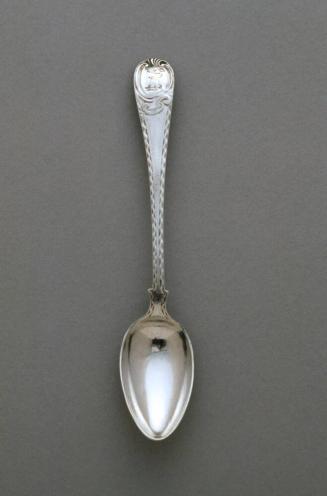
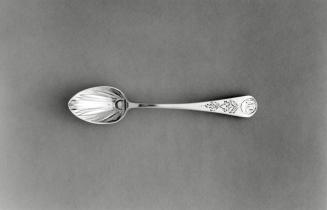
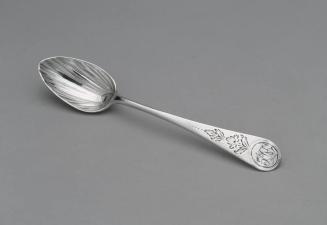
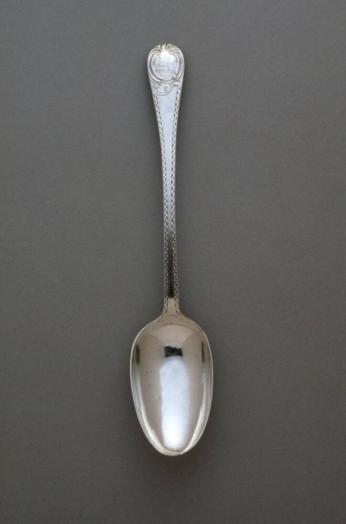
Paul Revere Jr.’s workshop and his apprentices produced a variety of silver tablewares, including tankards, pitchers, teapots, coffeepots, and flatware. His spoons, in particular, illustrate how Rococo and Neoclassical aesthetics could be incorporated into the smallest of functional forms. A group of spoons and teaspoons from his shop demonstrates this integration of style, distinguished by stamped Rococo cartouche terminals. Revere’s workshop is the only known American shop known to have employed this decorative device. By the third quarter of the 18th century, the profiles of spoons evolved, with handles bent slightly backward to accommodate changing tastes, a feature seen in this example.
This particular tablespoon was made in 1781 for two members of the Codman and Russell families, both of prominent Boston lineage. It commemorated the marriage of John Codman, a successful merchant and member of Boston’s elite, to Margaret Russell, daughter of the Honorable James and Katherine Graves Russell. Objects like this spoon were more than utilitarian tools; they served as markers of social status, taste, and family alliances among the Boston aristocracy.
ProvenanceJohn Codman and Margaret Russell Codman (1757–1789, m. 1781). [Firestone and Parson, Boston]; purchased by Thomas Jameson, Houston, 1986; given to MFAH, 2025.
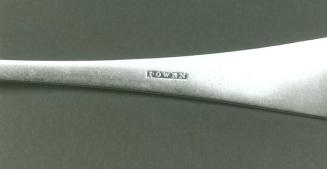
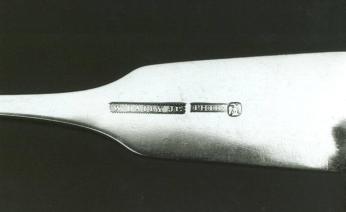
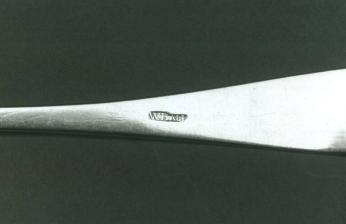
Published References Warren, David B., Michael K. Brown, Elizabeth A. Coleman, and Emily Ballew Neff, American Decorative Arts and Paintings in the Bayou Bend Collection. [Houston, Texas]: Museum of Fine Arts, Houston in association with Princeton University Press, 1998. p. 324, M111. This tablespoon is noted as in a “Houston private collection” under related examples. Inscriptions, Signatures and Marks
Cataloguing data may change with further research.
If you have questions about this work of art or the MFAH Online Collection please contact us.