Pictorial Embroidery

- Pictorial Embroidery
Explore Further
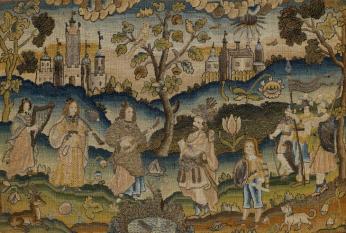
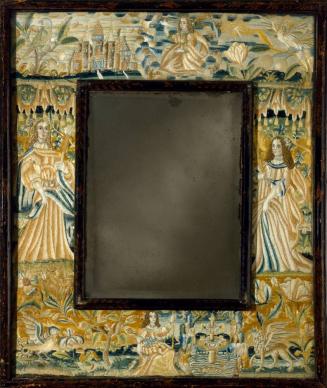
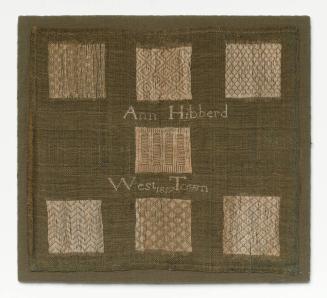
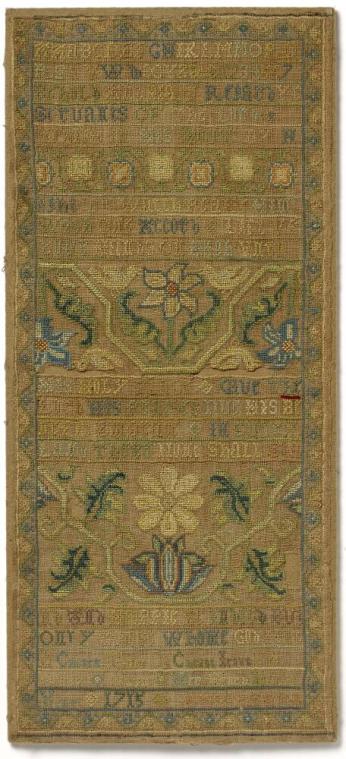
Among the distinctive forms of colonial needlework created by young women in the Philadelphia area are pictorial embroideries worked in silk thread on silk ground cloths. Such works began to appear as early as the 1730s, and most were stitched by accomplished needleworkers who had already mastered basic stitches, such as those commonly used in band samplers.
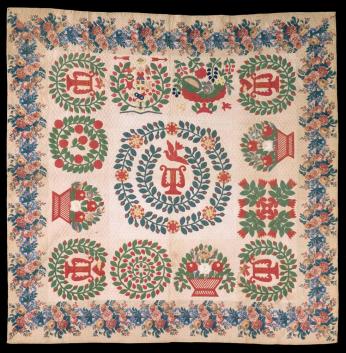
Although these embroideries feature a variety of subjects—including figures, animals, armorials, and landscapes—floral designs, often influenced by Indian textile patterns, were the most popular. These works clearly served as bravura demonstrations of the needleworker’s skill rather than as exercises in the more utilitarian stitchery seen in samplers and used to mark household linens.
This needlework depicts a two-handled basket resting on a grassy hillock dotted with small flowers or strawberries. Several flowering branches emerge from the basket, each featuring a different type of flower. The embroidery exhibits a variety of stitch types and textures, most notably in the body of the basket and the largest flowers.
ProvenanceElizabeth H. and Brian B. Topping; consigned to [Pook & Pook, Downingtown, Pennsylvania, October 1, 2025, lot 88]; purchased by [Amy Finkel, M. Finkel & Daughter, Philadelphia]; purchased by MFAH, 2026.
Inscriptions, Signatures and Marks
OLD EMBROIDERED PICTURE / ABOUT 1765 /
This Picture was embroidered by MARY ANN WHITEBREAD about 1765 while she / was in a convent in American where she had been placed by her wealthy English / father to prevent her from marrying Edward Bellamy. The parents intended to / come to American, but the lover, Edward Bellamy, came over on the next ship that / sailed – about three years later.
With the assistance of friends, he scaled the walls surrounding the con- / vent, covered the broken glass in the window with rugs, stole the lady and / married her. For this she was cut off in her father’s will with the Queen Anne’s / English shilling. Relatives sent her her wedding clothes and a set of 6 Chippen- / dale chairs, Chinese influence. She died in 1770 when her daughter was quite small.
Edward Bellamy was a Tory and went to the Carolinas after his wife died. / His daughter was brough up by a neighboring family and from time to time he / send money and letters by a traveling chair maker or peddlar who went down to / the Carolinas. At this time the daughter was about 18 years of age.
Later the chair maker of peddlar ceased his trips and became quite wealthy. / Also it was learned that the girl’s father had re-married and it was supposed / that he had sent her wedding dowry to her, but she never received it. The / daughter married a Michael Cress.
September 27, 1948
[Illegible] stown, Pa. [Doylestown?]
Bucks County
Cataloguing data may change with further research.
If you have questions about this work of art or the MFAH Online Collection please contact us.