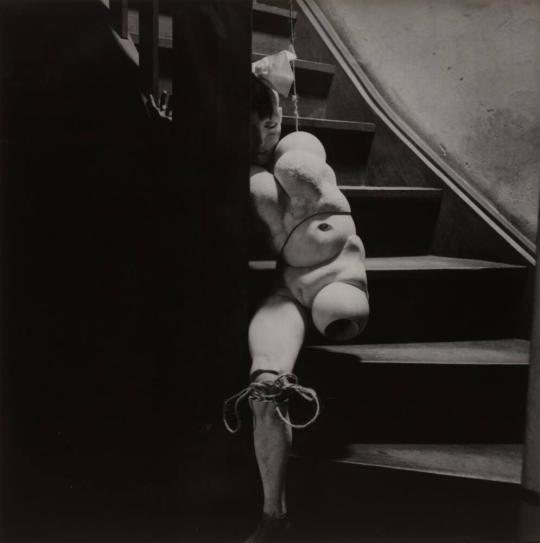
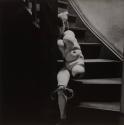
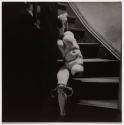
La Poupée, Berlin
Artist
Hans Bellmer (German, 1902–1975)German, 1902–1975
CultureGerman
Titles
- La Poupée, Berlin
Date1935, printed 1935–1938
MediumGelatin silver print
DimensionsImage: 18 7/8 × 18 7/8 in. (48 × 48 cm)
Sheet: 18 7/8 × 18 7/8 in. (48 × 48 cm)
Sheet: 18 7/8 × 18 7/8 in. (48 × 48 cm)
Credit LineGift of Marla and Andrew J Sobel
Object number2024.1097
Non exposé
Explore Further
Department
PhotographyObject Type
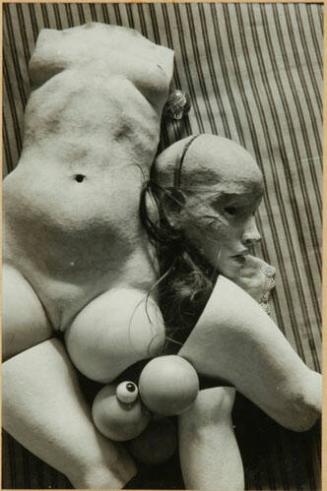
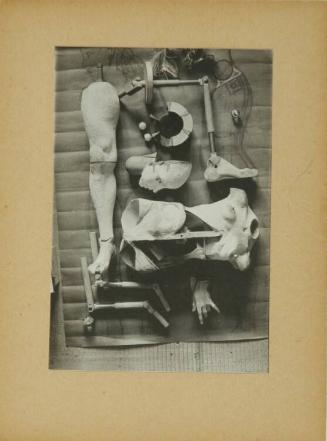
Created as the Nazis rose to power, La Poupée, Berlin embodies Hans Bellmer’s personal and political frustrations while addressing the failures of Western society to contain the base needs and violent impulses of humanity. Building off the doll as a symbol of childhood innocence and exploration, Bellmer plays out dark fantasies that manifest the constrictions of gender identity and sexual expression. To Bellmer and other Surrealists, dolls and automatons became stand-ins for the disconnect between the human body and modern life.
ProvenanceThe artist; given to Paul Éluard in the later 1930s or early 1940s; given to Alain and Jacqueline Trutat, likely between 1946–1952; purchased by a private collector, France, 1990s; [purchased by private dealer, Paris, 2011 via two intermediaries]; [purchased by Vintage Works, Ltd., Chalfont, Pennsylvania, 2011]; purchased by Andrew Sobel, Los Angeles, 2011; given to MFAH, 2024.
Published References Ilustrated: Cahiers d'art, May 1936, no.1 and 2, p.66, which was a special issue edited by Christian Zervos dedicated to the "Objets Surréalistes," exhibition at Charles Ratton's gallery in Paris at the same time.; Les jeux de la poupée,1949; Die puppe, Berlin,1962, p.95; Hans Bellmer, obliques, 1975, p.102; Eluard et ses amis peintres, paris, Centre Pompidou,1982, p.81; Hans Bellmer photographe, paris, Centre Pompidou,1983, p.92; L'Amour Fou, Photography & Surrealism, Washington, D.C.: The Corcoran Gallery of Art, New York: Abbeville Press, 1985; and Hans Bellmer, anatomie du desir, Centre Pompidou, 2006, p.100. Inscriptions, Signatures and Marks
[No inscriptions recto or verso]
Cataloguing data may change with further research.
If you have questions about this work of art or the MFAH Online Collection please contact us.