Desk and Bookcase
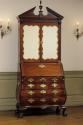

- Desk and Bookcase
Explore Further
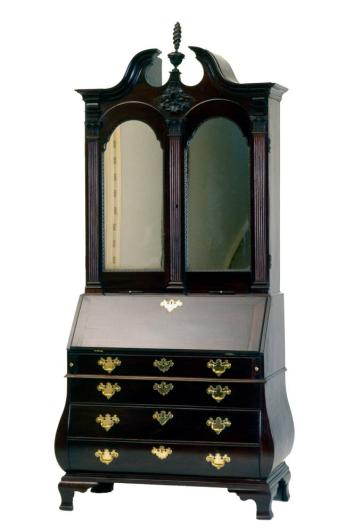
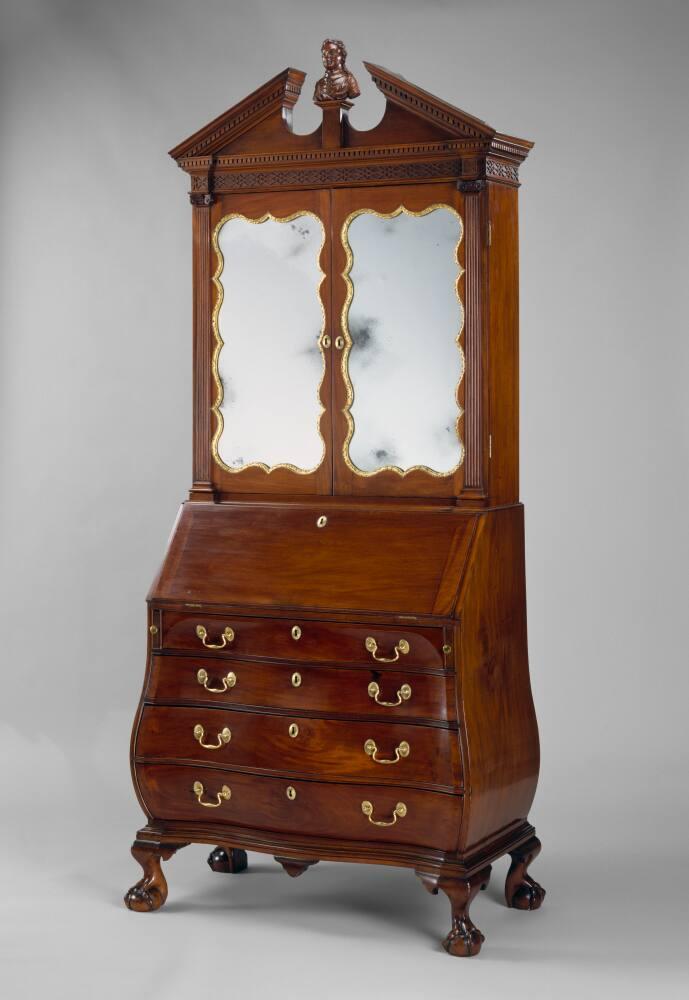
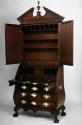
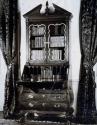
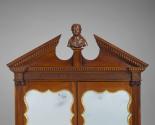
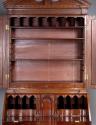
Few pieces of American furniture possess the sculptural qualities of this diminutive desk and bookcase. Notable for its bombé sides, the case exhibits an even greater complexity and movement with its serpentine front. This sense of motion is further accentuated by the scalloped mirrors framed within the bookcase doors. Although the desk’s scale and construction suggest it was produced toward the end of the century, as the popularity of the Rococo was beginning to diminish, it fully embraces the Late Baroque aesthetic. It is provocative to think that the desk’s original owner, Thomas Dawes, assumed a central role in its design and attentively oversaw its construction. Initially trained as a mason, he eventually became a recognized architect. Dawes was clearly versed with the bombé form, having designed a pulpit in this contour patterned after plate 112 in Batty Langley’s The City and Country Builder’s and Workman’s Treasury of Designs for Boston’s Brattle Street Church in 1772. His library included other important architectural volumes by James Gibbs, William Salmon, William Pain, and Colen Campbell, and books of furniture designs by Robert Manwaring. Perhaps these were a source of inspiration for the desk’s design, particularly its bombé shape, writing interior, and architectonic bookcase.
Related examples: Other bombé desk and bookcases with serpentine fronts include Podmaniczky and Zimmerman 1994; Monkhouse and Michie 1986, pp. 100–101, no. 41. Two desks are recorded in Mussey and Haley 1994, pp. 81–83, 86–87. Five bombé desk and book-cases with pitched pediments are recorded: Monkhouse and Michie 1986, pp. 100–101, no. 41; Vincent 1974b, pp. 186, 188–89; Fales 1976, pp. 236–37; one offered by Bernard and S. Dean Levy, New York. The fifth was restored with a pitched pediment, although evidence is inconclusive that this reproduces the original configuration. Its prospect door, pilastered document drawers, and ornamental fretwork on the bookcase are related to the Bayou Bend desk and bookcase (Conger 1991, pp. 168–69, no. 82). A group of serpentine-front bombé case pieces is attributed to John Cogswell’s (1738–1819) Boston shop in Mussey and Haley 1994. The authors do not include the Bayou Bend desk and bookcase in this group. Coincidentally, in 1773 Cogswell’s younger brother William married Thomas Dawes’s sister.
Book excerpt: Warren, David B., Michael K. Brown, Elizabeth Ann Coleman, and Emily Ballew Neff. American Decorative Arts and Paintings in the Bayou Bend Collection. Houston: Princeton Univ. Press, 1998.
ProvenanceThomas Dawes (1731–1809), Boston; by descent to his son Judge Thomas Dawes (1757–1825); by descent to his son Thomas Dawes (b. 1783); by descent to his daughter Sarah Ann (Mrs. Chauncey Parkman Judd, 1827–1919); by descent to her daughter Edith (Mrs. Edward Hall Nichols, 1863–1950); by descent to her son Hall Nichols; [Howard “Harry” Arons (1906–2000), Ansonia, Connecticut, 1954]; [David Stockwell (1907–1996), Wilmington, Delaware]; purchased by Miss Ima Hogg, 1954; given to MFAH, 1969.
Published References The Magazine Antiques 66 (October 1954), p. 237; Comstock, Helen. American Furniture, Seventeenth, Eighteenth, and Nineteenth Century Styles. New York: Viking Press, 1962, no. 329; Warren, David B. ‘‘American Decorative Arts in Texas: The Bayou Bend Collection of the Museum of Fine Arts of Houston.” The Magazine Antiques 90 (December 1966), p. 800; Warren, David B. “A Great Texas Collection of Americana: The Bayou Bend Collection at the Museum of Fine Arts, Houston.” The Connoisseur 178 (September 1971), p. 44, no. 13; Warren, David B. Bayou Bend: American Furniture, Paintings and Silver from the Bayou Bend Collection. Houston: Museum of Fine Arts, Houston; Boston: New York Graphic Society, 1975, p. 68, no. 134; Detwiller, Frederic C. “Thomas Dawes: Boston’s Patriot Architect.” Old-Time New England 68, nos. 1−2 (July–December 1977), pp. 6–7; Weidman, Gregory R. Furniture in Maryland, 1740−1940: The Collection of the Maryland Historical Society. Baltimore: Maryland Historical Society, 1984, p. 62, no. 24; Heckscher, Morrison H. American Furniture in the Metropolitan Museum of Art. New York: Metropolitan Museum of Art and Random House, 1985, p. 267, no. 174; Sack, Harold. “The Bombe Furniture of Boston and Salem, Massachusetts.” The Magazine Antiques 135 (May 1989), p. 1183; Mussey, Robert, and Anne Rogers Haley. “John Cogswell and Boston Bombe Furniture: Thirty-Five Years of Revolution in Politics and Design.” In American Furniture 1994. Edited by Luke Beckerdite. Hanover, N.H.: Chipstone Foundation, 1994, pp. 73, 101. Inscriptions, Signatures and Marks
Written on section's backboard: Dawes
Cataloguing data may change with further research.
If you have questions about this work of art or the MFAH Online Collection please contact us.