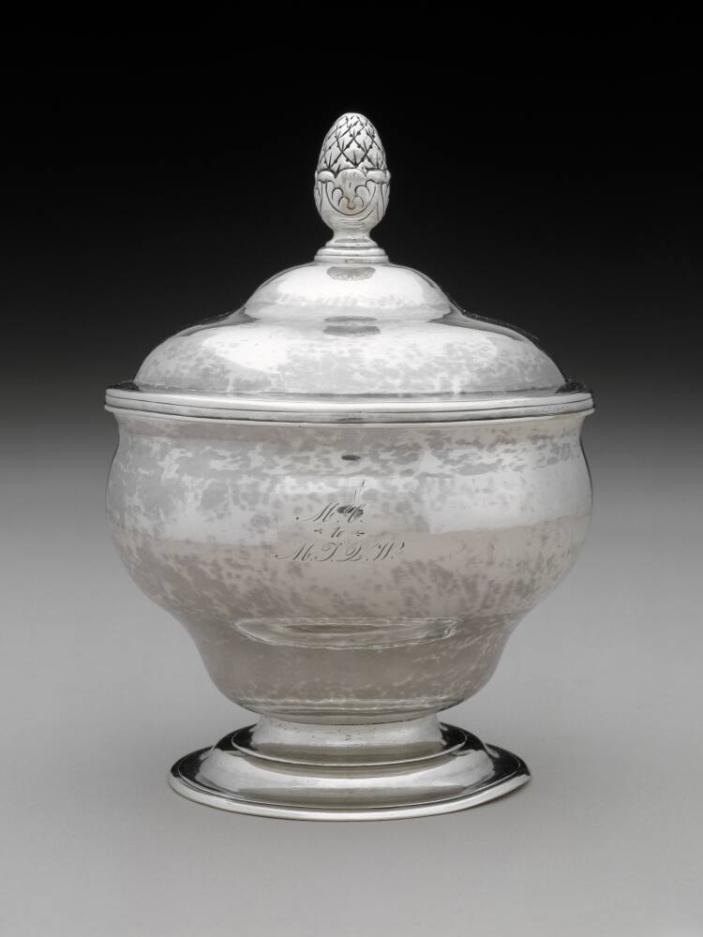
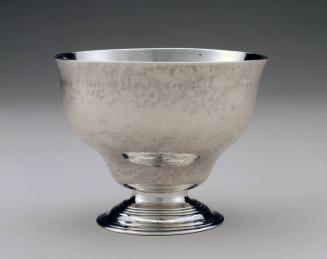
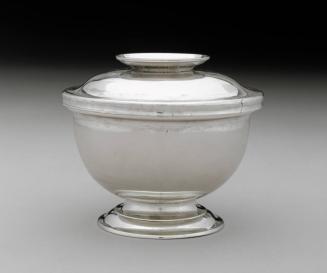
Sugar Dish
Maker
Paul Revere, Jr.(American, 1734–1818)American, 1734–1818
CultureAmerican
Titles
- Sugar Dish
Datec. 1755–1775
Made inBoston, Massachusetts, United States
MediumSilver
Dimensions6 1/8 × 3 5/16 in. diameter (15.5 × 8.4 cm)
Credit LineThe Bayou Bend Collection, gift of Miss Ima Hogg
Object numberB.69.109.A,.B
Current Location
Bayou Bend Collection and Gardens
Metals Study Room
Exposé
Explore Further
Department
Bayou BendObject Type
ProvenanceProbably made for Lucretia Greene (Mrs. John Callahan, 1748–1824, m. 1774), Boston; inherited by her daughter Mary Callahan (1776–1855); inherited by her niece Mary Timmins Quincy Hill (Mrs. Benjamin Pollard Winslow, 1813–1902); inherited by her son Alfred Erving Winslow (1839–1922); inherited by his son Dr. Charles Edward Amory Winslow (1877–1957); Anne R. Winslow (Mrs. Charles Winslow, 1876–1963), New Haven, Connecticut; purchased by Miss Ima Hogg, 1956; given to MFAH, 1969.
Exhibition History"Women Shaping Texas," The Bob Bullock Texas State History Museum, Austin, Texas, December 8, 2012–May 19, 2013.
Published References Phillips, John Marshall. Masterpieces of New England Silver 1650−1800. New Haven: Gallery of Fine Arts, Yale University; 1939, p. 72; Warren, David B. "A Great Texas Collection of Americana: The Bayou Bend Collection at the Museum of Fine Arts, Houston." The Connoisseur 178 (September 1971), p. 53, no. 27; Warren, David B. Bayou Bend: American Furniture, Paintings and Silver from the Bayou Bend Collection. Houston: Museum of Fine Arts, Houston; Boston: New York Graphic Society, 1975, p. 166, no. 317; Kane, Patricia E., ed. Colonial Massachusetts Silversmiths and Jewelers: A Biographical Dictionary Based on the Notes of Francis Hill Bigelow and John Marshall Phillips. New Haven: Yale University Art Gallery, 1998, p. 826. Inscriptions, Signatures and Marks
Engraved on side: M.C. to M.T.Q.H [Mary Callahan to Mary Timmins Quincy Hill] [added later]
Engraved beneath bowl: 13 oz, 12 dwt
Engraved beneath bowl: 13 oz, 12 dwt
Underneath body: mark of Paul Revere, Jr. [Buhler and Hood 1970, vol. I, p. 330, nos. 238–40, 243–47, 252–54]
Cataloguing data may change with further research.
If you have questions about this work of art or the MFAH Online Collection please contact us.

Edward Chandler Moore
c. 1865–1869
Silver and silver gilding
B.98.20.1,.2