Surveyor's Plain Compass

- Surveyor's Plain Compass
Explore Further
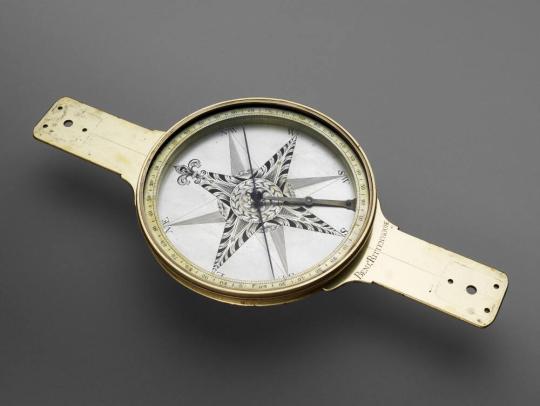
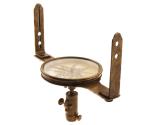
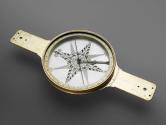
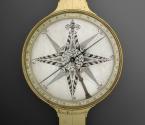
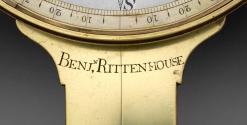
This surveyor’s compass was made in about 1775 by Benjamin Rittenhouse, younger brother of the famed instrument and clockmaker David Rittenhouse of Philadelphia. Benjamin became especially well known for the quality of his surveyor’s compasses; in 1798 Rufus Putnam, Surveyor General of the United States, referred to Benjamin Rittenhouse’s compasses as “the best I have seen.” In addition to their functional qualities, Benjamin Rittenhouse’s compasses are distinguished by their boldly designed and beautifully executed compass roses—the engraving of their faces indicating the cardinal and intermediate directions.
On the face of the compass, east and west are reversed from their ordinary configuration. This is explained by the fact that this compass was used not for finding directions, but for determining the deviation of a bearing from the north-south axis. Imagine that the compass needle and the indicator for north are aligned, but that the bearing to be measured is to the east. As the compass turns clockwise to align with the desired bearing, the needle remains stationary and will indicate the bearing in degrees to the east. After taking bearings and distance measurements in the field, the surveyor would then use the notes to draw a plan of the land parcel. Such work was much in demand in colonial America as settlement expanded and land changed hands.
ProvenanceBy inheritance from his father to Richard White, Seeley Lake, Montana; [Jeffrey D. Lock, Colonial Instruments, Tallmadge, Ohio]; purchased by MFAH, 2017.
Published References The present example is unpublished. The work of Benjamin Rittenhouse is discussed in: Silvio A. Bedini, “Benjamin Rittenouse and His Apprentices and Partners” in The American Surveyor, December 2004, http://www.amerisurv.com/PDF/TheAmericanSurveyor_BediniRittenhouseApprentices_December2004.pdf Silvio A. Bedini, Early American Scientific Instruments and Their Makers (Washington, D.C.: Smithsonian Institution, 1964; reprint London: Forgotten Books, 2015). Jeffrey Lock, “Construction Details of Rittenhouse Compasses,” in Professional Surveyor (December 2001), pp. 28¬–34. Charles E. Smart, The Makers of Surveying Instruments in America Since 1700 (Troy, N.Y.: Regal Art Press, 1962; reprint Mansfield Centre, Connecticut: Martino Publishing, 2011). Inscriptions, Signatures and Marks
Cataloguing data may change with further research.
If you have questions about this work of art or the MFAH Online Collection please contact us.