
Minerva (With Old and New Truths)
- Minerva (With Old and New Truths)
Explore Further
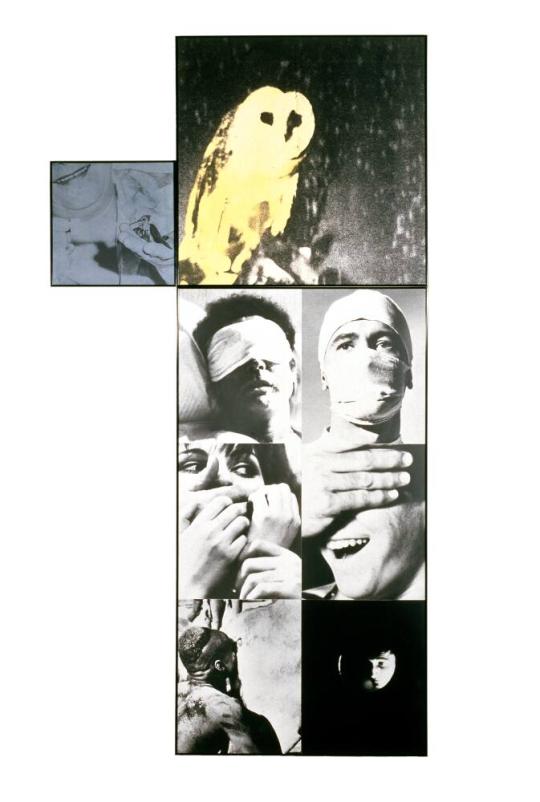
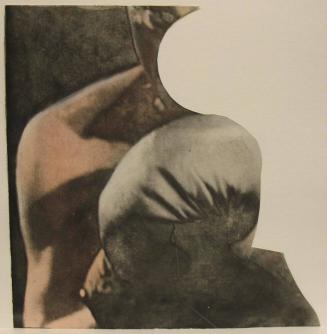
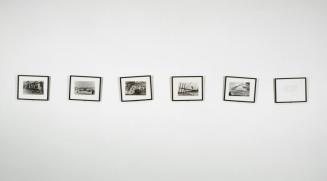
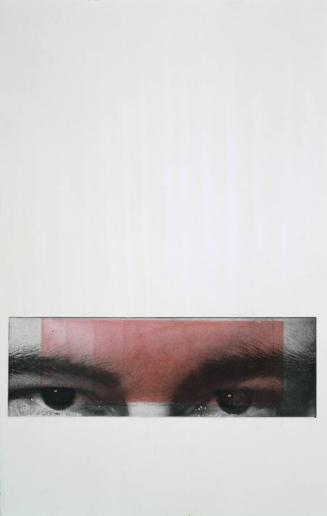
Minerva (With Old and New Truths) is a photographic collage composed of eight
fragmented images, taken from various preexisting sources (films and
photographs) and arranged vertically in the three panels. The title is taken
from a sentence of Hegel’s, “Minerva’s owl begins its flight only in the
gathering dusk.” It refers to the crystallization of Greek culture that accompanied
major classical literature and art in the period that saw the fall of the
previous Grecian civilization.
Together with his other complex photo-collages
of the 1980s, this work seems like a long meditation on Roland Barthes’s
statement from his 1966 essay “Introduction to the Structural Analysis of
Narratives,” “the narratives of the world are numberless…Must we conclude from
this universality that narrative is insignificant?” In this work of enigmatic
juxtaposition, Baldessari is neither willing to pin down any explicit narrative
nor to exclude alternative readings of its significance. Here, Baldesssari
seems to suggests a dialectic of “ability to see” and “inability to see” in the
arranged images.
ProvenanceSonnabend Gallery; MFAH, July 1989.
Exhibition History"Photographic Masterworks: Recent Acquisitions from the Museum of Fine Arts, Houston," Glassell School, January 23–March 4, 1990
"Contemporary Art and Photography: Spotlight on the Collection of the Museum of Fine Arts, Houston," Museum of Fine Arts, Houston, Upper Brown Pavilion, September 30, 2001–February 3, 2002.
"Ruptures and Continuities: Photography Made after 1960 from the MFAH Collection," Museum of Fine Arts, Houston, Brown Foundation Galleries, February 21–May 9, 2010.
"A History of Photography" (Rotation #2), Museum of Fine Arts, Houston, Lower Beck Corridor, May 1, 2015–June 21, 2015.
Published References John juxtaposes here an owl, the symbol of Minerva, the Roman goddess of war and wisdom with various pictures of sight and blindness or blocked vision. The works from this period combined cropped images from movie stills, which are images he says are part of our collective unconscious. But he also introduced more ancient references such as the one to Minerva. He wants our emotional response to the piece to be part of the process. [Coosje van Bruggen John Baldessari, The Museum of contemporary Art, Los Angeles and Rizzoli, 1990. Pg 131, our image reproduced on pg 208] "'For most of us photography stands for the truth,' Baldesari has said. 'But a good artist can make a harder truth by manipulating forms orpusing paint around. It fascinates me how I can manipulate the truth so easily by the way I juxtapose opposites or crop the image or take it out of context. When wo forces contend in a photograph, I may favor one side or the other --- the rider or the horse, for example, the unright mummy in its coffin or the woman standing in awe next to it. Cropping can make the outcome of a struggle ambiguous." [Coosje van Bruggen John Baldessari, The Museum of contemporary Art, Los Angeles and Rizzoli, 1990. Pg 214]
Cataloguing data may change with further research.
If you have questions about this work of art or the MFAH Online Collection please contact us.
![[Celluloid Buttons and Advertising Materials in Salesman Sample Case]](/internal/media/dispatcher/242465/thumbnail)