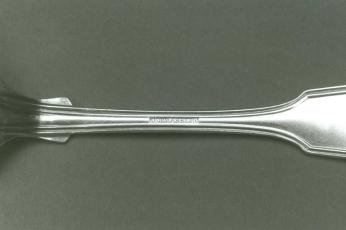
Ewer (one of a pair)
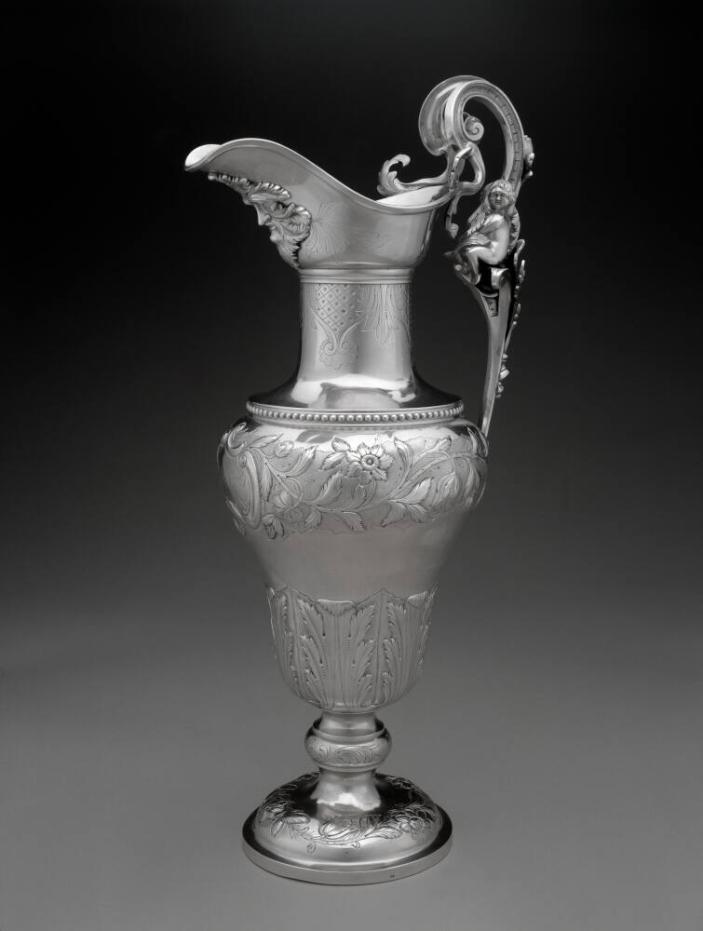

- Ewer (one of a pair)
Explore Further
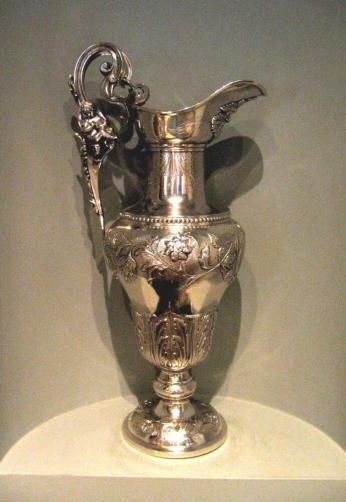
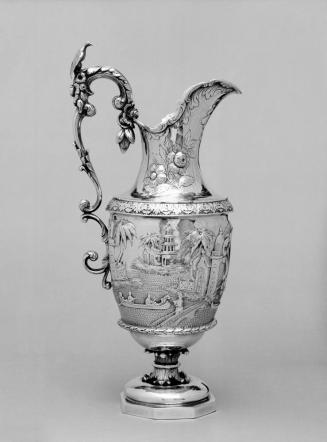
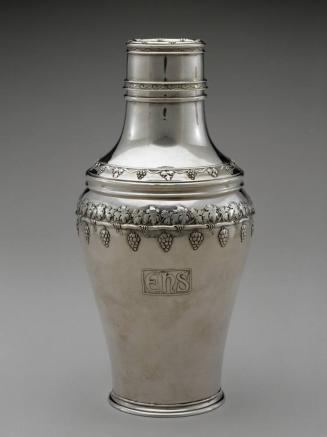
The eclecticism that defines nineteenth-century American art is exuberantly manifested in these remarkable ewers, which may have been intended more as decorative rather than functional objects. Their contours reproduce the inverted pear shape characteristic of Rococo silver, and the asymmetrical scrolls, flora, and putti are consistent with the prevailing Rococo Revival aesthetic. The startling juxtaposition of a Baroque mask, Neo-classical beading, Grecian-inspired acanthus leaves, and the exotic Persian diaper pattern produces a summation of nineteenth-century American taste.
Technical notes: The ewer consists of a foot rim, a foot, and raised body. The mask is cast. Aside from the engraved owner's monogram, the decoration is chased and repoussed.
Related examples: Sotheby’s, New York, sale 5968, January 24–27, 1990, lots 140–47.
Book excerpt: David B. Warren, Michael K. Brown, Elizabeth Ann Coleman, and Emily Ballew Neff. American Decorative Arts and Paintings in the Bayou Bend Collection. Houston: Princeton Univ. Press, 1998.
Provenance[Krupsaw’s Antique Shop, Washington, D.C.]; purchased by Miss Ima Hogg, 1967; given to MFAH, 1967.
Published References The Magazine Antiques 91 (May 1967), p. 596; Warren, David B. "A Great Texas Collection of Americana: The Bayou Bend Collection at the Museum of Fine Arts, Houston." The Connoisseur 178 (September 1971), p. 54, no. 29; Warren, David B. "Recent Acquisitions, The Belter Parlor at Bayou Bend." The Museum of Fine Arts, Houston Bulletin, n.s., 2, no. 3 (1971), p. 35; Warren, David B. Bayou Bend: American Furniture, Paintings and Silver from the Bayou Bend Collection. Houston: Museum of Fine Arts, Houston; Boston: New York Graphic Society, 1975, p. 178, no. 332. Inscriptions, Signatures and Marks
Cataloguing data may change with further research.
If you have questions about this work of art or the MFAH Online Collection please contact us.